

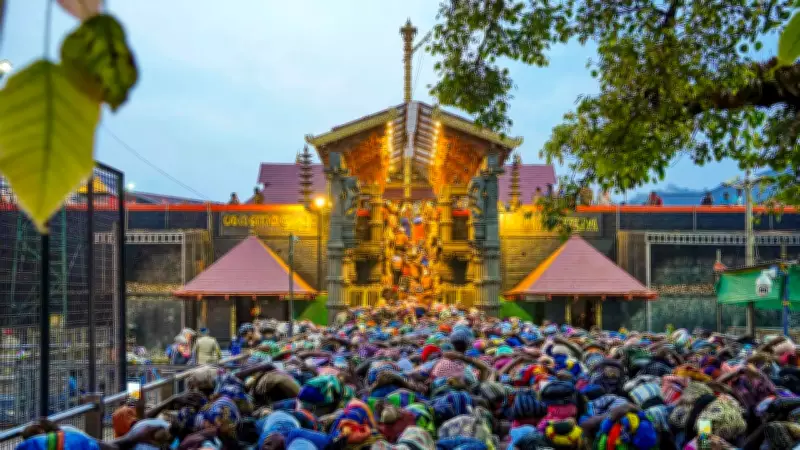
Supreme Court Judge Challenges Concept of 'Three-Day Untouchability' in Sabarimala Hearing
In a significant development during the ongoing Sabarimala temple case hearing, Supreme Court judge Justice BV Nagarathna made a powerful observation on Tuesday, questioning the notion of temporary untouchability based on menstrual status. The remarks came during arguments before a nine-judge constitutional bench examining discrimination against women at religious sites across India.
Justice Nagarathna's Powerful Analogy
"Speaking as a woman, there can't be a three-day untouchability every month, and on the fourth day, there is no untouchability," Justice Nagarathna remarked during the proceedings. Her statement directly challenged the concept that women could be considered "untouchable" during menstruation but acceptable at other times.
The observation came in response to Solicitor General Tushar Mehta's arguments representing the Centre. Mehta had strongly objected to the 2018 Sabarimala judgment's finding that barring women aged 10 to 50 from the temple amounted to "untouchability" under Article 17 of the Constitution.

Centre's Defense of Sabarimala Restrictions
Solicitor General Tushar Mehta presented several key arguments in defense of the Sabarimala temple's practices:
- "India is not that patriarchal or gender stereotyped in the way that the West understands," Mehta stated during his submission.
- He emphasized that the ban on women entering Sabarimala temple was not linked to menstruation but was imposed solely based on a specific age group.
- "Let us be clear. Sabarimala concerns only a particular age group. There should be no confusion," Mehta asserted.
- He noted that Lord Ayyappa temples across the country and worldwide remain open to women of all ages, with Sabarimala being a unique exception.
- "It is only one temple which has this restriction. It is a sui generis case," Mehta concluded, describing it as a special circumstance requiring distinct consideration.
Background of the 2018 Sabarimala Judgment
The current hearing revisits the landmark 2018 Sabarimala judgment where Justice DY Chandrachud delivered a powerful opinion. In that ruling, Justice Chandrachud held that:
- Barring women from Kerala's Sabarimala temple, whether due to age or menstrual status, amounts to "untouchability" under Article 17
- Such exclusion places women in a "subordinate" position within society
- The practice reinforces "patriarchy" and traditional gender hierarchies
- Most importantly, it fundamentally undermines women's dignity and constitutional rights
Constitutional Bench Composition and Scope
The nine-judge constitutional bench hearing these critical matters includes some of India's most distinguished jurists:
- Chief Justice Surya Kant
- Justice BV Nagarathna
- Justice MM Sundresh
- Justice Ahsanuddin Amanullah
- Justice Aravind Kumar
- Justice Augustine George Masih
- Justice Prasanna B Varale
- Justice R Mahadevan
- Justice Joymalya Bagchi
This bench is examining petitions concerning discrimination against women at various religious sites, with Sabarimala temple being a primary focus. The broader constitutional questions being addressed include:
- The extent and limits of religious freedom across different faiths in India
- How constitutional protections against discrimination interact with religious practices
- Whether age-based restrictions in religious contexts constitute discrimination
- The interpretation of "untouchability" under Article 17 in modern contexts
The hearing represents a crucial moment in India's constitutional jurisprudence, balancing religious traditions with fundamental rights to equality and dignity. Justice Nagarathna's remarks about "three-day untouchability" have brought renewed attention to how menstrual taboos intersect with constitutional protections, potentially shaping future interpretations of religious freedom and gender equality in India.






