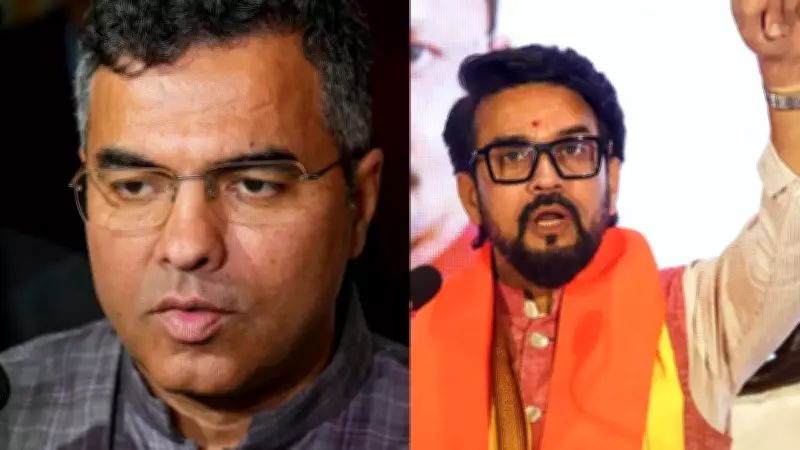
The Supreme Court has ruled that no cognisable offence was made out against BJP leaders Anurag Thakur and Parvesh Verma over their alleged hate speeches during the anti-CAA protests in Delhi in 2020.
Judgment Details
In a judgment delivered on 29 April, a bench of Justices Vikram Nath and Sandeep Mehta said it agreed with the findings of the Delhi High Court that the speeches did not disclose any cognisable offence. The case arose from a petition filed by CPI(M) leaders Brinda Karat and K M Tiwari, who had challenged a June 2022 verdict of the Delhi High Court. The high court had dismissed their plea against a trial court's refusal to direct registration of an FIR over the speeches.
Allegations and Background
The petitioners had alleged that Thakur made a hate speech at a rally in Rithala on January 27, 2020, and that Verma made inflammatory remarks the following day during the protests linked to the Citizenship Amendment Act at Shaheen Bagh. A trial court had earlier dismissed their complaint in August 2020, citing lack of sanction from the competent authority.

Supreme Court's Observations
In its ruling, the Supreme Court noted that the high court had independently assessed the material and found that the speeches were not directed at any specific community and did not incite violence or public disorder. "Upon a careful consideration of the material placed on record, including the alleged speeches, the status report dated February 26, 2020 submitted before the trial court, and the reasons recorded by the courts below, we are in agreement with the conclusion that no cognisable offence is made out," the court said.
Sanction Issue
However, the bench disagreed with the high court's reasoning on the issue of prior sanction under the Code of Criminal Procedure (CrPC). It said the legal framework does not bar the registration of an FIR or investigation at the pre-cognisance stage without sanction. "To hold otherwise would amount to introducing a restriction not envisaged by the legislature," the court said, adding, "The requirement of sanction is, therefore, a condition precedent only for taking cognisance and not for the registration of an FIR or for the conduct of investigation."
The court warned that making FIR registration dependent on prior sanction would undermine the statutory scheme and make investigation provisions unworkable. It emphasised that the criminal process must balance the rights of the accused with the interests of society. "While the requirement of sanction serves as a safeguard against frivolous or vexatious prosecution at the stage of cognizance, it cannot be permitted to operate as a shield to prevent the very initiation of the investigative process where a cognisable offence is disclosed," the bench said.
Timely Action and Rule of Law
The court also highlighted the importance of timely action by authorities. "Failure on the part of the authorities to perform their statutory duties at the threshold stage not only defeats the legislative intent but also places the ordinary citizen in a position of vulnerability against institutional inaction," it said. The bench stressed that investigations must proceed in accordance with the rule of law and without external influence. "Accordingly, while we disapprove the reasoning adopted by the high court on the issue of prior sanction, we find no ground to interfere with the ultimate conclusion," it said.
Hate Speech and Legal Framework
In its detailed 125-page verdict on a batch of pleas, the court described hate speech as "fundamentally antithetical" to constitutional values but said existing laws are sufficient to address the issue. Terming arguments of a legal vacuum as "misconceived", it added that the judiciary cannot create new offences or expand criminal liability beyond the existing legal framework.