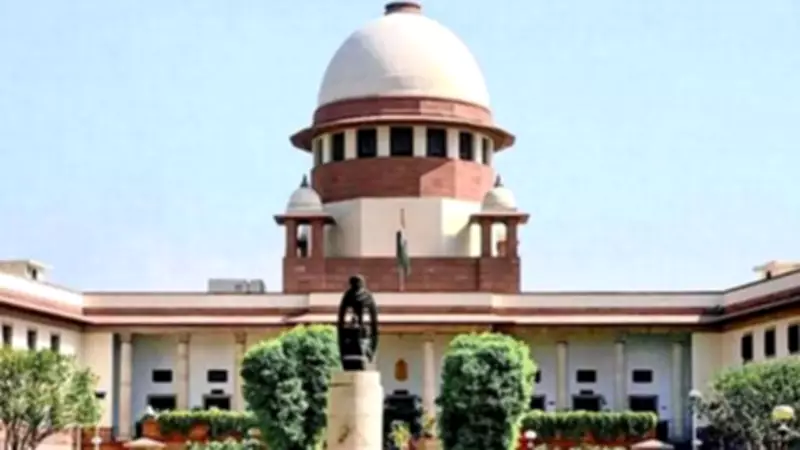
Supreme Court Bench Voices Concern Over Sweeping Judicial Orders
In a rare moment of introspection, a bench led by Chief Justice Surya Kant at the Supreme Court on Friday acknowledged that the apex court has, on multiple occasions, issued sweeping orders without fully considering India's complex social realities. The bench highlighted how such decisions, made from an "ivory tower" perspective, can inadvertently disrupt the social fabric and lead to unintended adverse consequences.
Hearing on BNS Provisions and FIR Registration Process
The remarks came during a hearing on a batch of petitions challenging the validity of certain provisions in the Bharatiya Nyaya Sanhita (BNS). Specifically, the petitions targeted the sedition clause in the BNS and a provision in the Bharatiya Nagarik Suraksha Sanhita (BNSS) that permits police to conduct a preliminary inquiry before registering a First Information Report (FIR).
Senior advocate Menaka Guruswamy argued that allowing police to conduct such preliminary inquiries violates the Supreme Court's 2014 ruling in the Lalita Kumari case. In that landmark judgment, the court had mandated that if a complaint discloses a cognizable offense, the police must immediately register an FIR. However, it allowed for preliminary inquiries in specific categories, such as matrimonial disputes and medical negligence cases.

Judicial Reflections on Social Impact and Abuse of Legal Processes
Chief Justice Kant questioned the practical implications of the Lalita Kumari ruling, pointing out instances of abuse. "Do you know how the Lalita Kumari ruling is abused by filing frivolous cases for registration of FIRs? How judicial forums are abused," he asked. He emphasized that in rural areas, complaints lodged in the heat of the moment, when converted into FIRs, can foster deep animosity within communities.
The CJI further stated, "We pass sweeping orders in the name of protecting fundamental rights which in reality disturb the social fabric." He suggested that when testing the validity of new laws, such as those in the BNS, it is prudent to wait a few years to observe their implementation. Only after identifying lacunae should challenges be mounted.
Debate Over Police Role in Verifying Complaints
Guruswamy countered by questioning how police could determine the veracity of a complaint at the FIR registration stage, arguing that this assessment should occur after the FIR is filed. In response, the bench posed a critical question: "If police can't determine the veracity of the complaint prior to converting it into an FIR, who else will?"
Justice Bagchi supported the bench's stance, noting that the Lalita Kumari judgment itself grants police the power to conduct preliminary inquiries in certain cases. He explained that the legislature has reflected this aspect in the law, particularly concerning the degree of punishment for offenses, and such provisions should not be seen as contradictory to the judgment.
Sedition Provision and Parliamentary Authority
Guruswamy also raised concerns about the inclusion of the sedition provision in the BNS, despite the Union government previously undertaking before the Supreme Court not to do so. The court clarified that while the government can give such undertakings, Parliament is not bound by them. Parliament holds exclusive power to enact legislation, and the Supreme Court's role is to interpret and potentially read down provisions when testing their validity.
The bench has scheduled the petitions for a detailed hearing in the second week of March, indicating that further deliberations on these contentious issues are forthcoming.