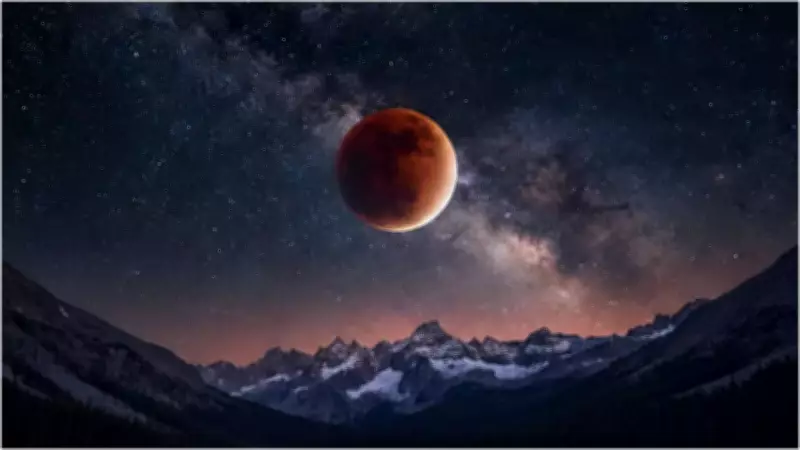
Total Lunar Eclipse to Illuminate Skies on Holi 2026
A spectacular total lunar eclipse, commonly referred to as a 'Blood Moon,' is set to grace the heavens on Tuesday, March 3, 2026. This celestial phenomenon holds particular significance as it coincides with the vibrant Hindu festival of Holi, creating a rare alignment of astronomical and cultural events that has captured the imagination of skywatchers across India and globally.
Eclipse Mechanics and Timing Details
The eclipse will occur when the Earth positions itself directly between the Sun and the Moon, casting its shadow upon the lunar surface. As the full Moon enters the Earth's umbra, or deep shadow, it will take on a striking reddish hue due to sunlight filtering through our planet's atmosphere. This optical effect, resulting from the scattering of shorter blue wavelengths and the transmission of longer red wavelengths, gives rise to the evocative 'Blood Moon' moniker.
Key timings for Indian Standard Time (IST) are as follows:

- The eclipse commences around 3:20 PM IST.
- The peak totality phase, offering the best viewing, spans from approximately 6:33 PM to 6:40 PM IST.
- The event concludes at 6:47 PM IST.
However, visibility across India varies significantly due to moonrise times. In major metropolitan areas such as Delhi, Mumbai, Bengaluru, and Chennai, the Moon will rise between 6:20 PM and 6:30 PM IST, allowing observers to catch only the concluding stages of the eclipse. Conversely, northeastern regions including Assam, Arunachal Pradesh, Meghalaya, and West Bengal will enjoy superior visibility, with earlier moonrise enabling a more extensive view of the reddish spectacle.
Viewing Prospects and Regional Variations
Most of India will witness partial phases of the eclipse, with the totality ending as the Moon ascends. For instance, Chennai residents may observe the final moments of totality for about 31 minutes post-sunset, while viewers in Cuttack could experience a longer duration. Kolkata and eastern parts might see up to 90% of the eclipse, whereas central and western cities will likely glimpse only a fraction during moonrise.
Importantly, lunar eclipses are entirely safe to watch with the naked eye, unlike solar eclipses that require protective filters. This accessibility makes it an ideal event for public engagement and amateur astronomy.
Scientific and Cultural Implications
From a scientific perspective, lunar eclipses provide valuable opportunities to study atmospheric effects on light and planetary interactions. Researchers utilize these events to analyze atmospheric composition and solar radiation scattering, contributing to broader astronomical knowledge.
Culturally, the coincidence with Holi, a festival celebrated on Phalguna Purnima (the full moon), adds a layer of significance. Astrologers and scholars note the eclipse's occurrence in the Purva Phalguni Nakshatra under the Leo zodiac sign, sparking discussions about ritual timings and Sutak Kaal—a period traditionally avoided for auspicious activities. This convergence has heightened public interest in religious calendars and customary practices, with diverse interpretations across communities.
Practical Viewing Tips and Future Events
To optimize the viewing experience:
- Seek locations with clear eastern horizons and minimal light pollution.
- Utilize binoculars or small telescopes to enhance details of the Moon's color transitions.
- Consider online live streams from scientific organizations for those unable to view in person.
Looking ahead, subsequent eclipses visible from India include a penumbral lunar eclipse on February 20, 2027, and a partial solar eclipse on August 2, 2027, with more events scheduled through 2029. Nonetheless, the 2026 total lunar eclipse stands out for its cultural resonance and widespread visibility, making it a highlight for Indian astronomy enthusiasts this year.