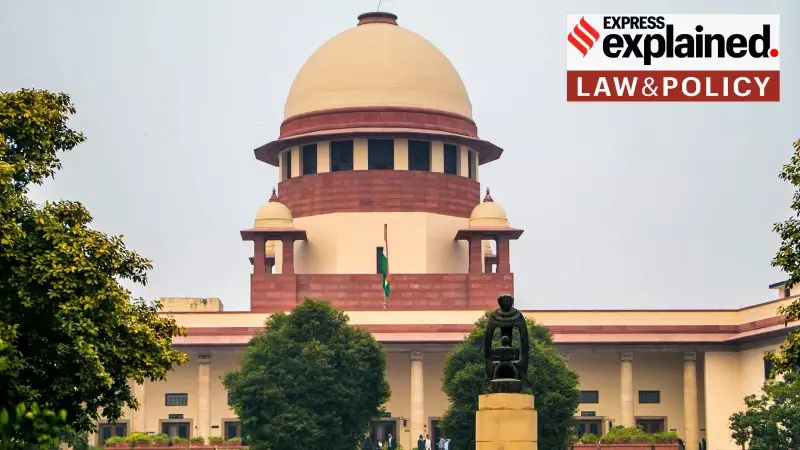
In a significant judgment reinforcing constitutional liberties, the Supreme Court of India has ruled that pending criminal cases cannot automatically bar a citizen from obtaining or renewing a passport. The apex court clarified that the right to a passport is an integral part of the inviolable right to life and personal liberty guaranteed under Article 21 of the Constitution.
The Core of the Judgment: Liberty vs. State Control
A Bench comprising Justices Vikram Nath and Augustine George Masih, in its December 19 ruling, underscored that liberty is not a gift of the State but its first obligation. This liberty inherently includes the freedom to move, travel, and pursue livelihood and opportunities. The court drew a crucial distinction between a blanket denial of a passport and court-supervised restrictions on foreign travel, stating that the former requires proportionality and judicial oversight.
The judgment stemmed from a case where passport authorities refused to renew the ordinary passport of Mahesh Kumar Agarwal, an Indian citizen, despite two criminal courts issuing "no objection" orders for the renewal. The Supreme Court has now set aside this refusal.

Case Background: The Legal Tangle of Mahesh Kumar Agarwal
Mahesh Kumar Agarwal was issued a ten-year ordinary passport in August 2013. During its validity, he faced legal proceedings in two separate cases. He was arraigned in a National Investigation Agency (NIA) case in Jharkhand involving allegations of extortion and funding a proscribed organisation. Separately, he was convicted in a CBI coal block case in Delhi and sentenced to four years' imprisonment, a sentence later suspended by the Delhi High Court pending his appeal.
In both matters, the courts had directed Agarwal to deposit his passport and barred him from leaving India without prior permission, conditions imposed to ensure his presence during trial and appeal. As his passport neared expiry in 2023, Agarwal sought permission for renewal.
The NIA court in Ranchi granted a no objection, released his passport solely for renewal, and required an undertaking that he would not travel abroad or seek a visa without permission. It ordered the renewed passport to be redeposited. Similarly, the Delhi High Court, while retaining travel restraints, held there was no legal basis to deny renewal for the standard ten-year period.
Despite these clear court orders, the Regional Passport Office declined to issue a regular passport, relying on Section 6(2)(f) of the Passports Act, 1967. This section mandates refusal where "proceedings in respect of an offence alleged to have been committed by the applicant are pending before a criminal court in India."
Supreme Court's Interpretation of the Law
The Supreme Court, proceeding on the assumption that renewal attracts the same scrutiny as a fresh issuance, held that Section 6(2)(f) cannot be an "unyielding bar" once conditions under the relevant exemption notification are met.
The court referred to Notification GSR 570(E) issued in 1993 under Section 22 of the Passports Act. This notification creates a controlled exemption from Section 6(2)(f) for persons facing criminal proceedings, provided the concerned court has applied its mind and the applicant furnishes an undertaking to appear when required.
Rejecting the approach of the passport authorities and the Calcutta High Court (which had dismissed Agarwal's petition), the apex court made several key observations:
The law does not require a criminal court to authorise a specific foreign trip as a precondition for passport issuance or renewal. Nothing in the Act or the notification compels courts to convert renewal permission into "a one-time licence to undertake a particular journey."
The court emphasised the distinction between the passport document and the act of foreign travel. A passport is a civil identity document, while foreign travel is a regulated activity. So long as criminal courts retain the power to permit or prohibit travel on a case-by-case basis, denying the passport itself overshoots statutory requirements.

The Bench cautioned against allowing legal procedures to become permanent obstacles, stating, "When procedural safeguards are converted into rigid barriers, or temporary disabilities are allowed to harden into indefinite exclusions, the balance between the power of the State and the dignity of the individual is disturbed."
The court also underlined that issuing a passport does not strip the State of control. Passport authorities retain powers under Section 10 of the Act to impound or revoke a passport if circumstances change, conditions are breached, or fresh court orders are passed.
Final Order and Implications
The Supreme Court directed the Regional Passport Office to reissue Agarwal's ordinary passport for the normal 10-year period within four weeks, subject to the continuing conditions imposed by the criminal courts in Delhi and Ranchi.
This judgment reiterates the primacy of judicial orders in such matters. The court noted that a 'No Objection Certificate' (NOC) from a court, as emphasised in a 2019 Ministry of External Affairs Office Memorandum, "would take precedence over any 'Adverse' report submitted by the police."
The ruling provides much-needed clarity for individuals entangled in criminal proceedings but whose travel is not currently prohibited by a court. It reinforces that the right to a passport, a gateway to the fundamental right to travel, cannot be summarily extinguished by administrative authorities when the judiciary has already put in place a framework to ensure the accused's presence and compliance.