

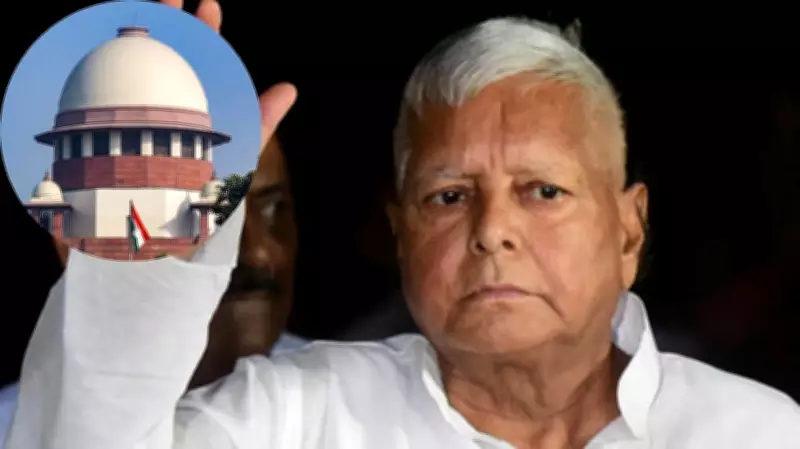
Supreme Court Declines to Hear Lalu Yadav's Plea in Land-for-Job Scam Case
The Supreme Court of India has made a significant ruling by declining to consider a plea filed by former Bihar Chief Minister and Rashtriya Janata Dal (RJD) leader Lalu Prasad Yadav. The petition sought to quash the Central Bureau of Investigation (CBI) case against him in the high-profile land-for-job scam, which has been a major point of legal and political contention.
Court's Focus on Legal Provisions
In its decision, the Supreme Court highlighted that the issues raised in Yadav's plea are intricately tied to the interpretation of specific legal provisions. The bench noted that the arguments centered on two key aspects:
- The scope and applicability of Section 17A of the Prevention of Corruption Act, which deals with prior approval for investigating public servants.
- The prospective application and operation of this same provision, questioning whether it applies retroactively to cases initiated before its enactment.
This focus indicates that the court is prioritizing a thorough legal examination over immediate dismissal, suggesting that the matter requires detailed judicial scrutiny rather than a summary disposal.

Background of the Land-for-Job Scam
The CBI case alleges that during Lalu Yadav's tenure as Railway Minister, jobs in the Indian Railways were exchanged for land parcels in a quid pro quo arrangement. This scandal has not only drawn attention for its alleged corruption but also for its implications on governance and public trust. The investigation has been ongoing, with multiple hearings and legal maneuvers shaping its trajectory.
Yadav's plea to quash the case was an attempt to halt these proceedings, arguing procedural and legal grounds. However, the Supreme Court's refusal to consider it means that the CBI's investigation will continue, potentially leading to further legal battles and hearings.
Implications for Legal Precedents
By emphasizing Section 17A of the Prevention of Corruption Act, the Supreme Court's decision could set important precedents for how corruption cases involving public officials are handled in India. This provision, aimed at protecting public servants from frivolous investigations, is now under judicial lens, and its interpretation in this context may influence future cases.
The court's stance suggests a cautious approach, ensuring that legal principles are upheld without prematurely dismissing serious allegations. This balance between protecting rights and enforcing accountability is crucial in high-stakes political and legal environments.
Political and Public Reaction
As a prominent figure in Indian politics, Lalu Yadav's legal troubles have significant political ramifications, especially in Bihar and national politics. The Supreme Court's ruling is likely to fuel debates on corruption, judicial independence, and the efficacy of anti-corruption laws.
Public and media attention remains high, with many viewing this case as a test of India's commitment to combating corruption at the highest levels. The continued legal process may impact Yadav's political career and the RJD's strategies moving forward.
In summary, the Supreme Court's decision to decline Lalu Yadav's plea marks a pivotal moment in the land-for-job scam case, steering it toward deeper legal examination rather than quick resolution. This underscores the judiciary's role in interpreting complex laws while addressing allegations of corruption in public office.






