Supreme Court Takes Strong Action Against Indore Police Officer
The Supreme Court of India has taken decisive action against a police officer in Indore. The court ordered the immediate removal of the officer from all investigative duties. This order came due to serious concerns about the officer's methods during investigations.
Court's Stern Directive on Police Practices
A bench comprising Justice Ahsanuddin Amanullah and Justice R Mahadevan issued this interim order on January 13. The order came during a Special Leave Petition filed by Anwar Hussain against the Madhya Pradesh government and others.
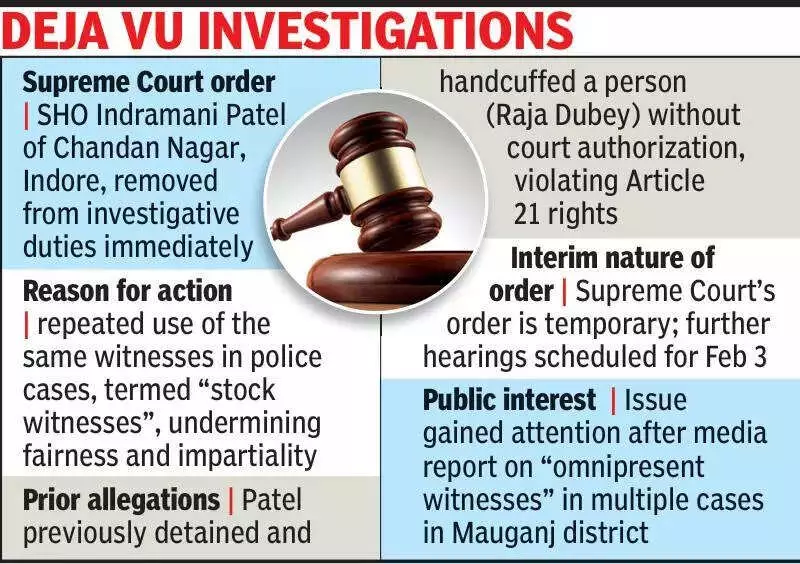
The court specifically named Indramani Patel, who served as the Station House Officer at Chandan Nagar police station in Indore. The bench directed that Patel must be immediately posted to police lines. He cannot perform any investigative duties or work at any police station until further orders.

The court made its position absolutely clear. If Patel attempts to interfere with any police station matters, the Commissioner of Police in Indore will be held personally responsible. The commissioner would need to answer directly to the court for any such interference.
Why the Court Took This Action
The Supreme Court expressed grave concern about a particular practice. The bench noted that Patel had repeatedly used the same witnesses in multiple police cases. The court described these individuals as 'stock witnesses.'
In its observation, the court stated this practice strikes at the very root of fair and impartial investigation. The bench called such methods 'anathema to a country governed by the rule of law.' This strong language underscores how seriously the court views these allegations.
The state government has received clear instructions. Authorities must file an affidavit confirming they have complied with the court's order. The court also directed that its instructions should reach all concerned authorities immediately. Officials should not wait for the formal upload of the order before taking action.
Previous Allegations Against the Officer
The Supreme Court took judicial notice of another matter involving the same officer. This case is currently pending before the Madhya Pradesh High Court in Indore.
The High Court had examined serious allegations against Patel. According to those proceedings, Patel illegally detained and handcuffed Raja Dubey on November 26, 2025. Dubey happens to be the brother-in-law of the petitioner in the current Supreme Court case.
Notably, Patel detained Dubey without registering any formal offence against him. When Patel appeared personally before the High Court on December 4, 2025, he admitted to both detaining and handcuffing Dubey.
However, Patel could not produce any order from a competent court authorizing the use of handcuffs. The High Court observed that his actions represented a gross violation of fundamental rights guaranteed under Article 21 of the Constitution.
The High Court had directed the Commissioner of Police to explain what departmental and criminal action would be taken against Patel.
Broader Context of 'Stock Witness' Controversy
The issue of 'stock witnesses' has attracted significant attention in Madhya Pradesh. The Times of India published a news item on January 13, 2026, titled "The usual suspects? Same 6 testify as MP govt witnesses in multiple cases."
This report highlighted allegations about what it called 'omnipresent' police witnesses in Mauganj district. Scrutiny of digital crime tracking records confirmed a troubling pattern. The same six individuals were reportedly cited as government witnesses in numerous cases.
These cases were registered at Laur and Naigadhi police stations in Mauganj district. The issue became a major controversy after these records came to light.
Activist Kunj Bihari Tiwari filed a complaint about this practice in 2022. He filed another complaint in December 2025. Following these complaints, the Superintendent of Police in Mauganj took action. The SP removed the SHO of Naigadhi police station, Jagdish Singh Thakur, and ordered a probe into the case.

Next Steps in the Legal Process
The Supreme Court clarified that its current order is interim in nature. The bench noted that its findings are tentative at this stage. The court will examine several documents during the next hearing.
These include the affidavit filed by the Commissioner of Police in Indore. The bench will also look into the role and responsibility of the concerned Additional Deputy Commissioner of Police.
The matter has been scheduled for further hearing on February 3. The court will continue its examination of these serious allegations at that time.