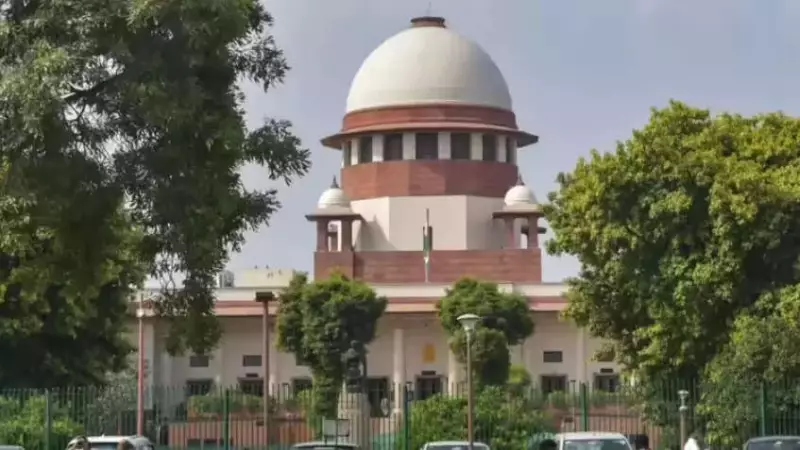
The Supreme Court of India has taken a significant step to address a growing challenge in the National Capital Region (NCR): gangsters exploiting jurisdictional boundaries to evade justice. On Tuesday, the apex court urged the central government to consider enacting a new law that would empower a single agency to pursue members of organised crime syndicates across Delhi and the NCR states without hindrance.
Modus Operandi of Jurisdictional Exploitation
A bench led by Chief Justice of India Surya Kant and comprising Justice Joymalya Bagchi highlighted the familiar pattern used by criminals. The bench noted that gangsters deliberately commit crimes in one state and then move to another within the NCR to dodge arrest, delay trials, and exploit these delays to secure bail. This fragmented approach across multiple police jurisdictions in Delhi, Haryana, Uttar Pradesh, and Rajasthan allows hardened criminals to benefit from systemic loopholes.
Justice Bagchi provided a clear example: "If a gangster commits 10 offences in Haryana, five in Rajasthan and two in Delhi, the NIA can be asked to investigate which would trigger invocation of the special law to enable trial of the accused in one court in NCR." This consolidated approach is seen as crucial for effective prosecution.

Proposal for Centralized Special Courts
During the hearing, CJI Surya Kant specifically suggested the creation of exclusive special courts for central laws like the Unlawful Activities (Prevention) Act (UAPA), Prevention of Money Laundering Act (PMLA), and Narcotic Drugs and Psychotropic Substances (NDPS) Act. These courts could be located in Delhi, Gurgaon, or Noida.
"Why not a law to cater to the entire National Capital Region? Create exclusive special courts for central laws... where the offences committed under the central laws would be tried irrespective of the location of the criminal incidents," CJI Kant told Additional Solicitor General Aishwarya Bhati.
The court's written order emphasized that in the absence of such a mechanism, "hardened criminals get the benefit of bail due to delayed trials at different locations, which may not be in the interest of society and the public." The bench advocated for an effective law to ensure optimum utilisation of the legal architecture.
Progress on Special Courts and Government Response
The hearing was part of the court's monitoring of progress in setting up exclusive special courts to try offences investigated by the National Investigation Agency (NIA). The Supreme Court had earlier directed that no existing court should be designated for this purpose; instead, new exclusive courts must be created to avoid being saddled with routine workloads.
ASG Aishwarya Bhati informed the court that the Centre has granted financial approval to reimburse states Rs 1 crore each for recurring and non-recurring expenditures to establish these exclusive special courts for NIA cases. Furthermore, ASG S D Sanjay stated that the Delhi government has decided to set up 16 such exclusive special courts within three months for trials under central penal laws.
While Bhati suggested the Supreme Court could take up the issue of a pan-NCR law suo motu and provide a framework, the bench clarified that this is primarily a legislative exercise for the government to undertake. The court's directive serves as a strong recommendation to streamline the fight against organised crime in India's capital region.