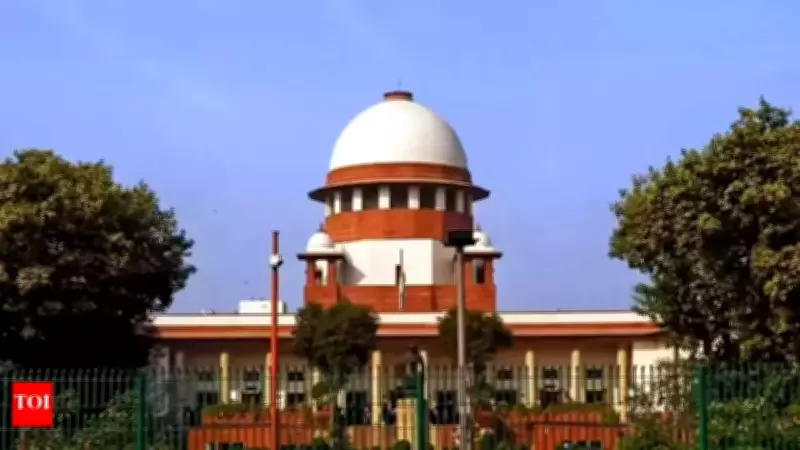
The Supreme Court on Monday sought responses from the Centre, the National Commission for Protection of Child Rights (NCPCR), and the National Human Rights Commission (NHRC) on a plea seeking a complete ban on the employment of children and adolescents in orchestras, dance troupes, spas, massage parlours, and similar establishments, as per a report by PTI news agency.
Petition Allegations
The petition alleged that these sectors had increasingly been used as fronts for child trafficking, sexual exploitation, and forced labour. It highlighted that minor girls as young as 10 years old were being employed in orchestras and dance bars.
Supreme Court's Response
A bench comprising Chief Justice Surya Kant and Justices Joymalya Bagchi and Vipul M Pancholi issued notices to the Union ministries of labour and law and justice. The bench heard submissions from senior advocate H S Phoolka, appearing for child rights collective Just Rights for Children Alliance (JRCA). Phoolka told the court that minor girls as young as 10 years old were being employed in orchestras and dance bars. He also noted that for spas and massage parlours, some states have set 18 years as the minimum age. Taking note of the allegations, the bench termed the issue "serious" and also issued notices to the NCPCR and NHRC.

Details of the PIL
The Public Interest Litigation (PIL) seeks directions to the Central Government to exercise its powers under Section 4 of the Child and Adolescent Labour (Prohibition and Regulation) Act, 1986 (CALPRA) to amend its schedule. Specifically, it seeks to include the employment or performance of children below 18 years in orchestras, dance bars, dance troupes, nautanki performances, massage parlours, spas, and salons, or any similar establishments that depict children in obscene or exploitative manner in Part A of the Schedule to CALPRA, thereby categorically prohibiting such employment.
If included under Part A, employment of adolescents — defined under the law as those aged between 14 and 18 years — in such sectors would be entirely banned rather than merely regulated. The petition argued that there was a major "enforcement vacuum" in the existing law. Under CALPRA, hazardous occupations are listed under Part A, where employment of adolescents is entirely prohibited. However, massage parlours and spas are currently listed under Part B, where adolescent labour is only regulated. Orchestra and dance troupe sectors are not listed at all under the hazardous occupations schedule.
Exploitation and Trafficking Concerns
According to the petition, traffickers exploited this legal ambiguity by presenting the commercial sexual exploitation of minors as "lawful employment" in entertainment and wellness industries. The PIL claimed these establishments had become "clandestine fronts" for organised trafficking networks operating across several states.
The petition cited rescue operation data between March 2025 and May 2026, claiming that 212 minors were rescued from orchestras and dance groups in Bihar and West Bengal, while 12 minors were rescued from massage parlours and spas in Delhi and Rajasthan. According to the plea, several victims were as young as 12 years old.
The petition alleged that children from poor families were lured with promises of dance training, glamour jobs, or film opportunities. Many were then allegedly sold to operators for amounts ranging between Rs 10,000 and Rs 50,000. It also alleged that victims were forced into debt bondage and made to perform before intoxicated audiences in sexually provocative clothing.
Supporting Evidence
The plea additionally cited a 2023 report by the Bharatiya Institute of Research and Development (BIRD), which found that 44.04 per cent of identified trafficking victims in India are minors and that spas are frequently used as fronts for disguised sexual exploitation. The petitioner argued that unless the law was amended to explicitly prohibit child and adolescent employment in such sectors, enforcement agencies would continue facing significant difficulties in prosecuting offenders.