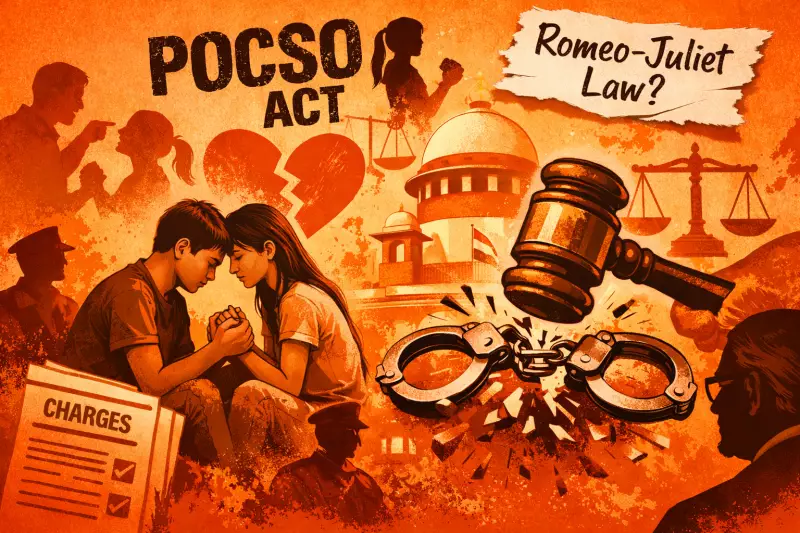
The Supreme Court of India has taken a decisive step to address a growing legal concern. On Friday, a bench comprising Justices Sanjay Karol and N Kotiswar Singh issued a significant directive. They asked the central government to consider introducing a special provision. This provision is often called a "Romeo-Juliet" clause.
What is the Romeo-Juliet Clause?
A Romeo-Juliet clause refers to a legal exemption. It aims to protect consensual romantic relationships between teenagers or young adults who are close in age. The name draws inspiration from Shakespeare's famous star-crossed lovers. In legal contexts, such clauses prevent severe criminal penalties from applying to these relationships. Instead, they recognize the reality of adolescent romance.
The Problem with POCSO Act Misuse
The Protection of Children from Sexual Offences Act, known as POCSO, became law in 2012. Its primary goal was to protect minors from sexual abuse and exploitation. However, courts across India have observed a troubling trend in recent years. The law is increasingly being misapplied in cases involving consensual teenage relationships.

Judges have repeatedly noted instances where POCSO is used for purposes other than its intended one. Some cases involve families or individuals filing complaints to settle personal disputes. These actions criminalize behavior that involves mutual consent between adolescents. This misuse places young people at risk of harsh legal consequences.
Supreme Court's Direct Intervention
The Supreme Court bench explicitly took "repeated judicial notice" of this misuse. They highlighted how the law's strict provisions are affecting genuine adolescent relationships. The court did not merely make an observation. They issued a concrete order to address the situation.
The judgment has been directed for circulation to the Union Law Secretary. This ensures the central government's law department receives the court's concerns formally. The court wants the government to consider specific steps to "curb this menace."
Proposed Legal Changes
The Supreme Court suggested two main actions. First, they recommended creating a legal carve-out or exception. This would exempt consensual close-in-age relationships from the harshest parts of the POCSO Act. Second, they called for action against those who misuse the law to "settle scores." This could involve penalties for false complaints.
This move signals a potential legal rethink. It acknowledges that laws designed to protect children can sometimes harm them when applied without nuance. The court's intervention pushes for a balance between protection and proportionality.
Why This Matters for Teen Relationships
Teen relationships are a common part of adolescent development. Criminalizing them under a strict abuse prevention law creates several problems. It can traumatize young people, burden the judicial system, and divert resources from actual abuse cases. A Romeo-Juliet clause would recognize the difference between exploitative abuse and consensual romance among peers.
The Supreme Court's stance reflects evolving judicial thinking. It shows a willingness to adapt legal frameworks to social realities. This development could lead to significant reforms in how India handles cases of adolescent relationships under criminal law.