
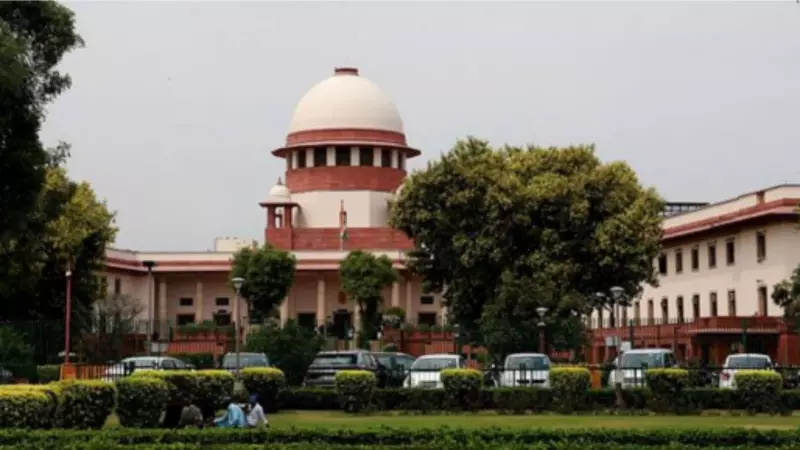
In a significant ruling underscoring the independence of the lower judiciary, the Supreme Court of India on Monday set aside the removal of a Madhya Pradesh judicial officer who was accused of bribery and showing double standards in granting bail. The apex court held that a wrong exercise of discretion in granting bail, by itself, cannot be a ground to initiate departmental proceedings against a trial court judge.
A Case of Judicial Orders Under Scrutiny
The case pertained to Nirbhay Singh Suliya, who was serving as an Additional District and Sessions Judge in Madhya Pradesh. He faced disciplinary proceedings and was ultimately removed from service. The allegations stemmed from his judicial orders granting bail in certain cases under the Excise Act, where large quantities of liquor were seized. The inquiry against him noted that while he granted bail in some cases involving over 50 bulk litres of liquor, he rejected bail in other similar cases, citing the large quantity as a reason.
A bench comprising Justices J B Pardiwala and K V Viswanathan heard the appeal. The court found that the appellant was held guilty of misconduct "only based on certain judicial orders granting bail without anything more." The bench agreed with Suliya's counsel, stating there was no material on record to show that extraneous considerations, like bribery, actuated those bail orders. The hypothesis of misconduct was drawn merely because the orders did not expressly reference the statutory provision.
Court Condemns Perverse Findings and Intimidation
Justice K V Viswanathan, writing the judgment, strongly criticized the findings of the inquiry committee constituted by the state High Court. He stated that the findings were "perverse and are not supported by findings on record." He added that "on the available material, no reasonable person would have reached the conclusion that inquiry officer reached."
The judgment delivered a powerful message on protecting judicial officers from intimidation. "A fearless judge is the bedrock of an independent judiciary, as much as an independent judiciary itself is the foundation on which rule of law rests," Justice Viswanathan observed. He pointed out that disgruntled litigants or even mischievous elements within the legal fraternity sometimes engineer false and anonymous complaints to intimidate trial court judges.
The court recommended strict action, including contempt proceedings and referral to Bar Councils, against individuals who file such frivolous and false complaints. However, it also balanced this by asserting that if a complaint is prima facie true, prompt disciplinary action must be initiated, and in appropriate cases, even criminal prosecution should follow to weed out tainted judges.
Concurring Opinion on Judicial Discretion and Corruption
In a concurring opinion, Justice J B Pardiwala echoed the central principle. He asserted that "a mere wrong order or wrong exercise of discretion in grant of bail by itself, without anything more, cannot be a ground to initiate departmental proceedings." He warned that initiating proceedings on mere suspicion makes trial court judges reluctant to exercise their discretionary powers, such as in bail matters, which is essential for a functioning justice system.
Justice Pardiwala also addressed the critical issue of corruption, stating it cannot be tolerated at any level in the judiciary as it undermines justice and erodes public trust. He clarified that when a complaint of misconduct is found prima facie true, stringent action must follow. The bench collectively emphasized that the autonomy of trial courts must not be compromised, concluding that "when autonomy of trial courts is compromised by higher courts and fear takes precedence over judicial duties, democracy and the rule of law suffer."
The Supreme Court's ruling, delivered on January 5, 2026, thus reinstates the judicial officer while drawing a clear line between judicial error and misconduct, aiming to fortify the independence of the district judiciary.