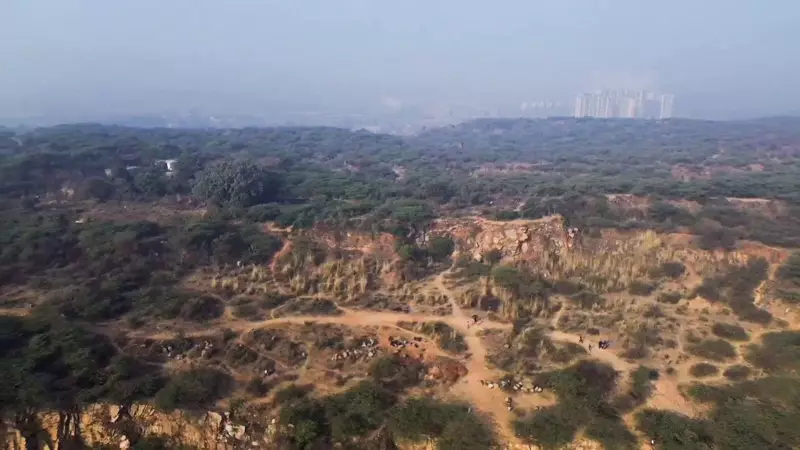
In an extraordinary legal development, the Supreme Court of India has effectively put its own recent judgment on hold. On Monday, a special bench led by Chief Justice of India Surya Kant stayed a November 20 ruling that had redefined the Aravalli hills. The Court has decided to form a new expert panel to resolve critical ambiguities in the case.
A Rare Act of Judicial Self-Correction
This decision is unprecedented for several key reasons. It represents a de facto review initiated by the bench itself in a suo motu case, rather than through a conventional review petition filed by an aggrieved party. The intervention comes just days after former Chief Justice B.R. Gavai, who authored the contentious November 20 ruling, publicly defended its reasoning in a television interview.
Adding to its rarity, the November 20 ruling was delivered by a three-judge bench. It has now been stayed by a bench of the same strength. This goes against established legal precedent where a later bench, on an issue of law, is bound to follow the decision of an earlier bench of equal or higher strength.
Historical Context of Supreme Court Reviews
While the Supreme Court has reviewed its rulings in the past following widespread public outcry, such self-correction is extremely rare and has typically been at the behest of litigants or the executive branch. The current suo motu intervention follows days of public demonstrations against what was perceived as a dilution of protections for the critical Aravalli ecological barrier.
History provides a few parallels. In February 2019, a bench headed by Justice Arun Mishra ordered states to evict forest dwellers whose land claims under the Forest Rights Act were rejected. Facing public criticism, the same bench stayed its own order just two weeks later, after the Centre sought a modification.
Similarly, in March 2018, a two-judge bench issued safeguards that restricted arrests under the SC/ST (Prevention of Atrocities) Act. The ruling triggered protests, leading the SC to refer the issue to a larger bench and subsequently recall its judgment, though this was also prompted by a government review plea.
The Court's Role as Environmental Guardian
The Supreme Court's swift suo motu action underscores how it perceives its own role as a guardian of India's environment. The judiciary has built significant public credibility through its public interest litigation on environmental causes.
Key environmental interventions led by the SC include:
- Monitoring Delhi's air pollution since 1984 through the continuing mandamus in the M.C. Mehta case.
- Driving the conversion of Delhi's public transport fleet to Compressed Natural Gas (CNG).
- Taking up forest conservation in the landmark 1995 Godavarman Thirumulpad vs Union of India case, tightening norms for reducing forest cover.
The Court has a long history of protecting the Aravallis. As early as 1996, it prohibited mining and construction in parts of Haryana and cracked down on illegal mining in the range. Notably, a bench headed by Justice Gavai in 2023 had prohibited the Delhi Development Authority (DDA) from allotting land in the ecologically sensitive Delhi Ridge area.
The decision to pause the November ruling and seek fresh expert review highlights the complex balance between legal definitions and ecological preservation, reaffirming the Supreme Court's active role in one of India's most vital environmental debates.