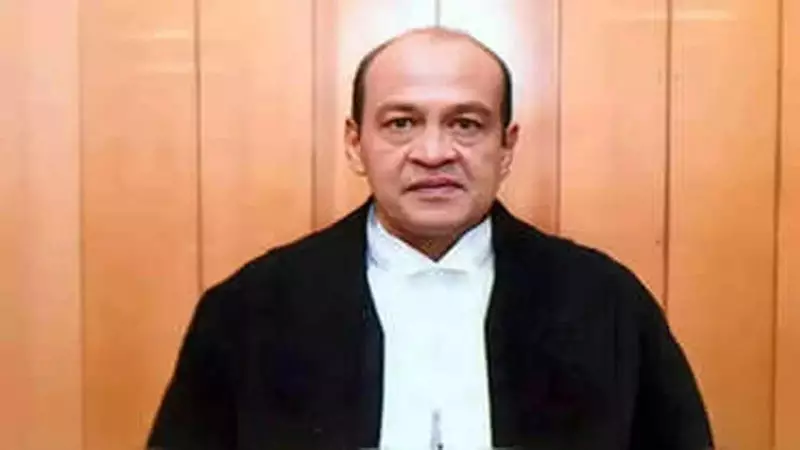
The Supreme Court of India has stepped into a significant constitutional matter, agreeing to hear a petition filed by Allahabad High Court judge Justice Yashwant Varma. The judge is challenging the very formation of an inquiry committee set up by the Lok Sabha Speaker to investigate corruption allegations leveled against him.
Bench Issues Notices, Flags Procedural Lapse
A bench comprising Justices Dipankar Datta and Augustine George Masih took up the matter on Tuesday. The court issued formal notices to the office of the Lok Sabha Speaker and the secretaries-general of both Houses of Parliament, seeking their detailed responses. This action came after senior advocate Mukul Rohatgi, representing Justice Varma, brought to light a critical "procedural lapse" in how the inquiry panel was constituted.
Rohatgi argued before the bench that when a motion for the removal of a judge is introduced in both Houses of Parliament, the rules mandate that the subsequent inquiry committee must be formed jointly by the Lok Sabha Speaker and the Rajya Sabha Chairman. He contended that the Lok Sabha Speaker does not possess the unilateral authority to constitute such a panel on his own.

The Core of the Legal Challenge
Elaborating on the legal argument, Rohatgi cited the established procedure. He stated that if notices of a motion for removal are presented to both Houses on the same date, no committee can be formed unless the motion is formally admitted in both chambers. Furthermore, if the motion is admitted in both the Lok Sabha and the Rajya Sabha, the inquiry committee must be a joint endeavor, constituted by the Speaker and the Chairman together.
In his petition, Justice Varma has not only challenged the constitution of the committee but has also sought a declaration that the Lok Sabha's admission of the motion to remove him is "contrary to law." The Supreme Court has scheduled the next hearing in this pivotal case for January 7.
Background of the Allegations and Prior Proceedings
The case stems from a major incident on March 14, when substantial amounts of currency were reportedly discovered at Justice Varma's official residence in Delhi. He was serving as a High Court judge in the capital at the time and was later transferred to the Allahabad High Court in Uttar Pradesh.
Following the discovery, the then Chief Justice of India (CJI), Justice Sanjiv Khanna, initiated an in-house inquiry. A three-member panel was formed, which submitted its findings on May 4. The panel concluded that Justice Varma was guilty of misconduct. Based on this report, the then CJI advised the judge to resign, warning of impeachment proceedings if he refused.
After Justice Varma declined to resign, the report was forwarded to President Droupadi Murmu and Prime Minister Narendra Modi. The judge subsequently approached the Supreme Court to invalidate the in-house inquiry report, but his plea was dismissed on August 7. Subsequently, on August 12, Lok Sabha Speaker Om Birla constituted a separate three-member committee to probe the charges, the legality of which is now under the Supreme Court's scrutiny.