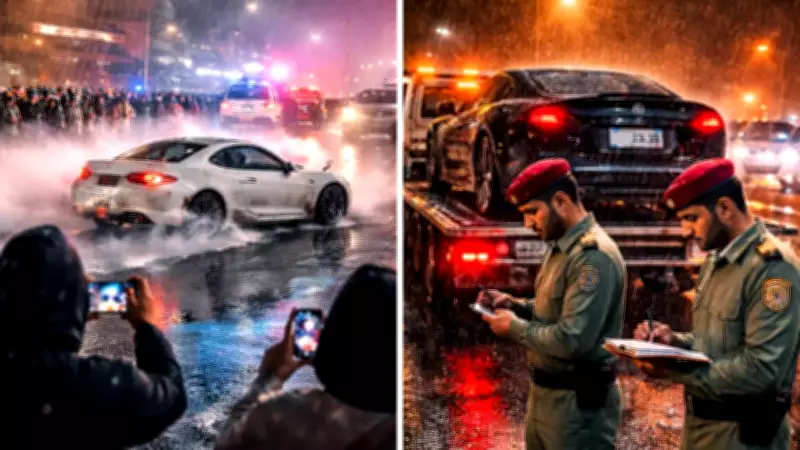
Sharjah Police have initiated a robust legal crackdown targeting motorists who engaged in perilous driving stunts during recent rainfall, confiscating multiple vehicles and taking decisive action against eight drivers whose reckless conduct endangered lives on public roads.
Viral Footage Triggers Police Action
The incident gained widespread attention after footage circulated on social media, showing cars skidding and spinning on wet tarmac. This visual evidence prompted Sharjah Police to review the clips and identify the offenders, highlighting a growing emphasis by UAE law enforcement on combating reckless behavior and enhancing road safety across the emirate.
Rain Transforms Roads into Stunt Arenas
Last week, heavy rain in Sharjah led to unusual behavior from some motorists, who turned the slick roads into impromptu playgrounds for dangerous stunts. Authorities emphasized that such conduct is not a harmless thrill but a serious violation of federal traffic laws. Rain creates inherently dangerous conditions, with reduced tire grip and increased stopping distances heightening the risk of loss of control and collisions.

The Traffic and Patrols Directorate warned that what may start as a fun stunt can "turn moments of enjoyment into life-threatening scenarios," especially when vehicles slide unpredictably on wet surfaces.
Stringent Penalties Under UAE Traffic Law
Under the UAE's Federal Traffic Law, the apprehended drivers face multiple penalties. For driving in a manner that endangers life and public safety, each offender will be fined AED 2,000 and receive 23 black points on their licence, along with vehicle impoundment of up to 60 days under Article 1(A).
An additional offence, operating a vehicle on the road without licence plates, carries AED 3,000 in fines, an additional 23 black points, and up to 90 days of impoundment under Article 4.
Police noted that accumulating the yearly limit of 24 black points can lead to licence suspension and court proceedings, ensuring that repeated offenders may face even harsher consequences. This strong enforcement action reflects broader efforts to deter dangerous driving behavior, particularly in challenging weather conditions when the margin for error is smaller and the potential cost in human life is higher.
Broader Safety Push Across the UAE
The Sharjah crackdown aligns with a larger pattern of enforcement and public safety messaging across the UAE. In recent months, law enforcement agencies in other emirates have also taken firm action against reckless behavior behind the wheel.
For example, Dubai Police impounded a high-performance vehicle and took legal action after a driver posted clips of dangerous stunts online, highlighting risks posed by showboating on public streets. Similarly, Abu Dhabi Police arrested a driver livestreaming while weaving through traffic, emphasizing that reaching for social media views should never come at the cost of road safety.
These combined efforts echo steadfast guidance from traffic authorities that dangerous driving, whether fueled by weather spectacle, social media, or thrill-seeking, will not be tolerated.
Applying Traffic Laws to Changing Behavior
Sharjah's current enforcement also reflects how authorities are applying existing traffic law provisions to changing behavior patterns. According to a driving regulation guide issued by the Sharjah Police, violations such as driving dangerously or operating a vehicle without proper documentation attract significant fines, black points, and vehicle confiscation periods, all designed to serve as strong deterrents.
Community Cooperation Urged for Safety
Police have not only punished the eight drivers but also appealed to the public to play an active role in monitoring and reporting unsafe driving practices. Members of the community were urged to report serious traffic violations immediately by dialing 999 for emergencies or 901 for non-emergency cases, reinforcing the idea that road safety is a shared responsibility between authorities and residents alike.

The emphasis on such public participation reflects a broader traffic safety strategy in the UAE, where enforcement, awareness, and community vigilance work in tandem. Authorities contend that encouraging responsible driving habits is as important as penalizing reckless conduct, especially during adverse conditions like rain, which already elevate risk levels.
Heightened Risks During Rainfall
Weather-related road incidents, even when not involving stunts, are known to heighten risk. Rain reduces tire traction, increases braking distances, and can dramatically change a vehicle's handling characteristics. While many drivers adapt to these conditions with caution, others misjudge their vehicle's capabilities or overestimate their own skills.
What might appear to be fun, such as spinning tires or drifting on wet roads, can quickly turn into serious crashes with injuries or fatalities. Traffic authorities have repeatedly stressed that rain is not an invitation to test driving limits but a time for heightened caution.
In wet conditions, even routine maneuvers require slower speeds, longer following distances, and mindful steering, lessons often reinforced by accident statistics and public safety campaigns.
Fostering a Culture of Responsible Driving
While the legal action against the eight drivers has made headlines, it also serves as a cautionary tale for drivers across the UAE. As authorities step up enforcement and penalties remain stringent, motorists are reminded that public roadways are shared spaces where individual choices can have far-reaching consequences.
Reckless behavior, whether performing stunts, livestreaming while driving, or ignoring hazardous conditions, does not only risk fines and impoundment. It can lead to serious injuries, loss of life, and long-term legal consequences such as licence suspension and court appearances.
Sharjah Police's message is clear: enjoying weather and scenic conditions should never come at the cost of safety. The emirate's legal action underscores a firm commitment to preserving lives, reducing road accidents, and fostering a culture of responsible driving that protects all road users.