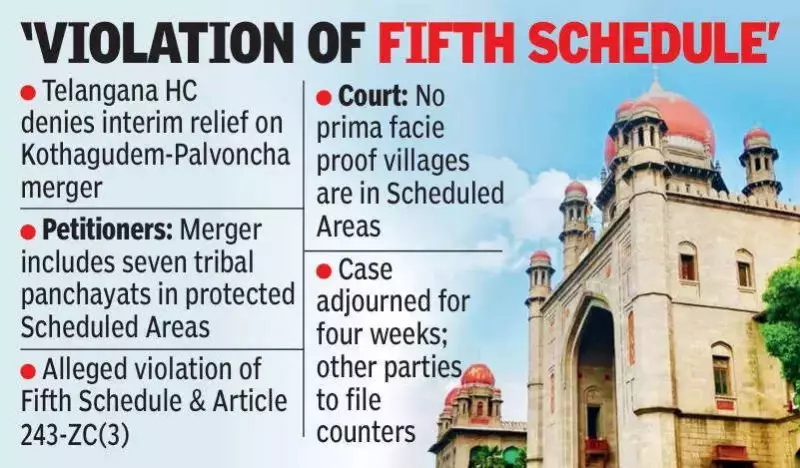
Telangana High Court Rejects Interim Relief in Municipal Merger Dispute
The Telangana High Court delivered a significant ruling on Monday. It declined to grant interim relief in a petition challenging the formation of the Kothagudem municipal corporation. This case centers on the merger of Kothagudem and Palvoncha municipalities in Bhadradri Kothagudem district.
Petitioners Allege Constitutional Violations
Social worker Potru Praveen Kumar and Azmeera Naresh of Palvoncha filed the petition. They contend that the merger illegally includes seven tribal gram panchayats located in protected scheduled areas. According to the petitioners, this action violates mandatory constitutional safeguards.
The state government's decision to upgrade these tribal regions through GO No. 177 and Act No. 17 of 2025 faced sharp criticism. The petitioners argue it was carried out in complete disregard of the Fifth Schedule of the Constitution. Their counsel submitted that the state bypassed essential procedures by shifting these areas from Schedule I to Schedule II of the Telangana Municipalities Act without proper authority.

Key Legal Arguments Presented
The petition makes several serious allegations. It claims Article 243-ZC(3) of the Constitution was not complied with. This article prohibits the extension of municipal laws to scheduled areas unless expressly authorized by Parliament.
Furthermore, the petitioners pointed out that the administrative action runs contrary to a 2022 judgment of a division bench of the high court. That judgment had categorically directed that no municipality be constituted within scheduled areas until Parliament formally extends the relevant laws.
According to the petitioners, the state's move infringes upon fundamental rights guaranteed under Articles 14, 19, 21, and 300-A of the Constitution. They seek the restoration of Kothagudem and Palvoncha as independent municipalities to safeguard the legal protections afforded to tribal communities.
Court's Observations and State's Response
The state government filed counters firmly denying all allegations. However, the court noted the absence of immediate material to establish the status of the land in question. The bench observed that the petitioners had failed to prima facie demonstrate that the merged villages formed part of a scheduled area as defined under the 1950 Presidential notification.
Finding no grounds to grant interim relief at this stage, the court directed other implead petitioners to file their counters. It then adjourned the matter for four weeks. This decision allows for further examination of the complex legal issues involved.
The case highlights ongoing tensions between development initiatives and constitutional protections for tribal areas. Both sides will continue their legal arguments when the matter reconvenes next month.