

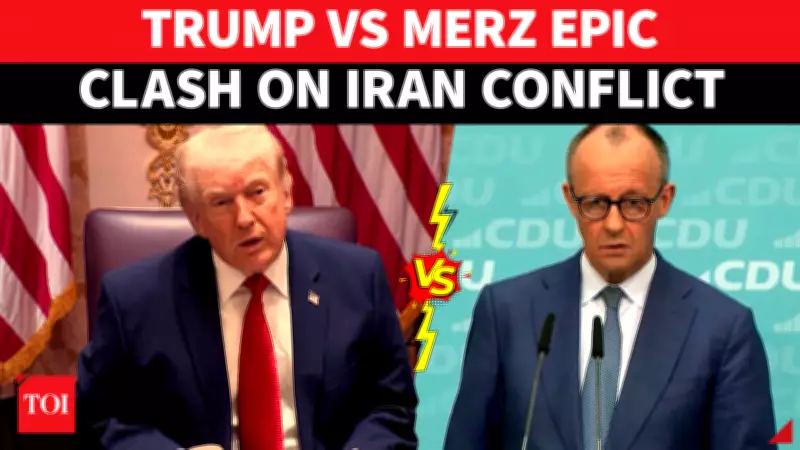
Trump and Merz in Heated Exchange Over Global Conflicts
A significant diplomatic confrontation has unfolded between former US President Donald Trump and German opposition leader Friedrich Merz, centering on the ongoing conflicts in Iran and Ukraine. The exchange, marked by sharp rhetoric, underscores the deepening divisions in transatlantic relations as global tensions escalate.
Trump's Provocative Remarks on War Responsibilities
Donald Trump launched a pointed critique against European nations, particularly targeting Germany, by questioning their commitment to international security. In a statement that has reverberated across political circles, Trump asserted, "If Iran isn't your war, then Ukraine isn't my war." This comment directly challenges Europe's stance on the Middle East crisis, implying a conditional approach to American involvement in Ukraine based on European actions in Iran.
Furthermore, Trump hinted at a potential strategic shift in US military deployments, suggesting that resources could be reallocated between regions. This move signals a harder line from the US, emphasizing a transactional view of global alliances that prioritizes direct national interests over collective security efforts.

Merz's Diplomatic Response and Call for Cooperation
In contrast to Trump's confrontational tone, Friedrich Merz adopted a more measured and diplomatic approach. He emphasized the importance of international cooperation and dialogue to resolve conflicts peacefully. Merz specifically pushed for ceasefire talks with Iran, advocating for a de-escalation of hostilities in the Middle East.
Merz's response highlights Germany's continued emphasis on diplomatic solutions and multilateral engagement, even as conflicts intensify. By offering cooperation, he seeks to bridge the growing gap between US and European strategies, though the exchange reveals starkly different priorities on handling global crises.
Implications for Transatlantic Relations and Global Stability
This war of words between Trump and Merz brings to the forefront the escalating transatlantic tensions. The US appears to be taking a more isolationist and hardline stance, while Germany and other European nations stress the need for dialogue and collective action. As conflicts in the Middle East and Ukraine continue to worsen, this divergence in approaches could complicate international efforts to achieve peace and stability.
The situation is further exacerbated by ongoing military escalations, such as Iran's fortification of strategic locations and external support from countries like Russia. These developments add layers of complexity to the already volatile geopolitical landscape, making diplomatic resolutions increasingly urgent yet challenging.
Key Takeaways from the Exchange:- Trump's remarks reflect a shift towards conditional support in US foreign policy, tying involvement in Ukraine to European actions in Iran.
- Merz's diplomatic tone underscores Europe's commitment to peaceful resolutions and multilateral cooperation.
- The clash highlights deepening rifts in transatlantic alliances, with potential impacts on global conflict management.
- Escalating conflicts in both regions demand coordinated international responses, but differing strategies may hinder progress.
As the world watches, the outcome of this diplomatic standoff could shape future engagements in Iran and Ukraine, influencing not only regional stability but also the broader framework of international relations. The need for cohesive action remains critical, yet the path forward is fraught with political and strategic challenges.






