

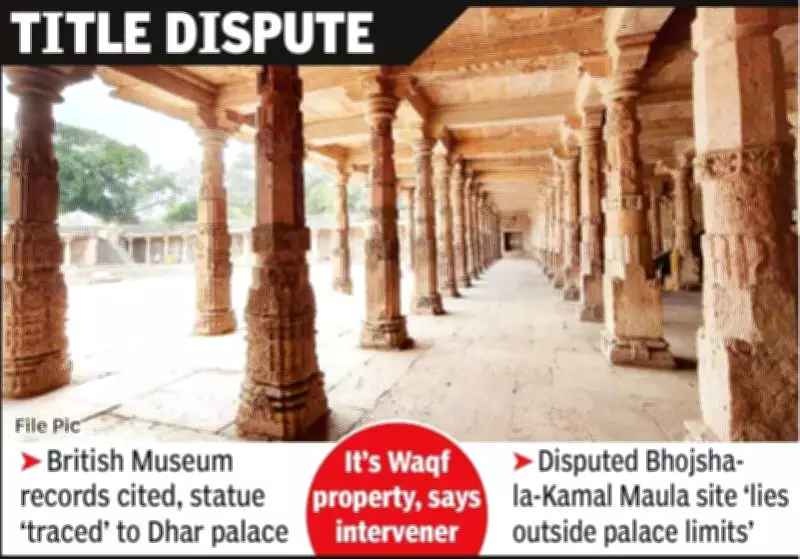
Court Hears Arguments in Bhojshala-Kamal Maula Mosque Dispute, Statue Origin Challenged
In a significant development in the ongoing legal battle over the Bhojshala-Kamal Maula mosque complex in Dhar, Madhya Pradesh, an intervener in the petition filed by Hindu Front for Justice presented evidence to the Indore bench of the Madhya Pradesh High Court on Saturday. The intervener, represented by Advocate Ashhar Warsi, argued that the Vagdevi statue, housed in the British Museum and claimed to be excavated from the disputed site, was actually recovered from the ruins of Raja Bhoj's palace in 1875.
Historical Records and Maps Presented in Court
Advocate Ashhar Warsi, appearing before the bench of Justice Vijay Kumar Shukla and Justice Alok Awasthi, placed British Museum records before the court. These documents establish that Major General William Kincaid recovered the Vagdevi statue from the ruins of Dhar's city palace in 1875, not from the Bhojshala-Kamal Maula mosque site. To support this claim, Warsi presented historical maps showing that the mosque complex falls entirely outside the boundaries of the erstwhile city palace.
"The petitioners have abused the law by placing forged documents before this court," Warsi told the bench, alleging that the evidence presented by Hindu Front for Justice was misleading. He claimed to represent 'the Muslim community of Dhar' in addition to the interveners, emphasizing the community's stake in the dispute.

Challenges to Temple Claims and Historical Naming
Warsi further submitted that the petitioners have failed to produce conclusive proof that Bhojshala was ever a temple. He argued that their case relies solely on architectural similarities to suggest the existence of a Goddess Saraswati temple, which he deemed insufficient. Additionally, he pointed out that the name 'Bhojshala' is a colonial-era coinage, emerging in the late 1800s when the British began referring to the site as 'Raja Bhoj's School.'
The site has been consistently identified as the Kamal Maula mosque in historical records, Warsi asserted. He told the court that Hindu prayers at the site are documented only from 1952, when a demand was first raised for holding a Bhoj Utsav. This demand was rejected by the then Director of the Archaeological Survey of India, who stated that the site was a mosque.
Legal and Historical Evidence on Mosque Status
Citing a Dhar State Gazette from 1935, Warsi submitted that the document explicitly refers to the site as a mosque. "The exact words were that it shall remain a mosque and the absolute right to worship remains with the Muslims," he quoted. On the question of ownership, Warsi countered the petitioners' contention that the site is not Waqf land. He noted that following a survey, the land was declared Waqf property in 1985, with a statutory one-year window provided for objections.
Warsi also highlighted procedural issues, pointing out that the petition was filed in 2022 and the Waqf Amendment Act came into force in 2025, yet the petitioners made no corresponding amendments to their petition. He argued that since the property is Waqf land, any challenge to that status should have been brought before the Waqf Tribunal or through a civil suit, not as a Public Interest Litigation (PIL) before the High Court. "The petitioner should have filed a civil suit or moved the tribunal," he emphasized.
Invocation of Archaeological and Worship Acts
To strengthen his arguments, Warsi invoked key legislative provisions:
- Section 4 and Section 13 of the Ancient Monuments and Archaeological Sites and Remains Act, 1958: These sections establish that the disputed site is a mosque under the custody of the Archaeological Survey of India (ASI), and its character cannot be altered without proper authorization.
- Section 3 of the Places of Worship (Special Provisions) Act, 1991: This section mandates that the religious character of a place of worship as it existed on August 15, 1947, must be maintained, further supporting the mosque's status.
Warsi used these acts to argue that the site's designation as a mosque is legally protected and historically documented, making any attempts to change its character legally untenable.

Next Steps in the Legal Proceedings
The court has scheduled the next hearing for April 20, when Advocate Ashhar Warsi will continue his arguments. This ongoing case highlights the complex interplay of historical evidence, legal jurisdiction, and religious identity in disputes over heritage sites in India. The outcome could have significant implications for similar cases across the country, as courts grapple with balancing archaeological findings, community rights, and legislative frameworks.
As the hearing progresses, stakeholders from both sides await further developments, with the intervener's evidence challenging long-held assumptions about the site's history and ownership. The case underscores the importance of rigorous historical research and adherence to legal procedures in resolving such sensitive disputes.





