
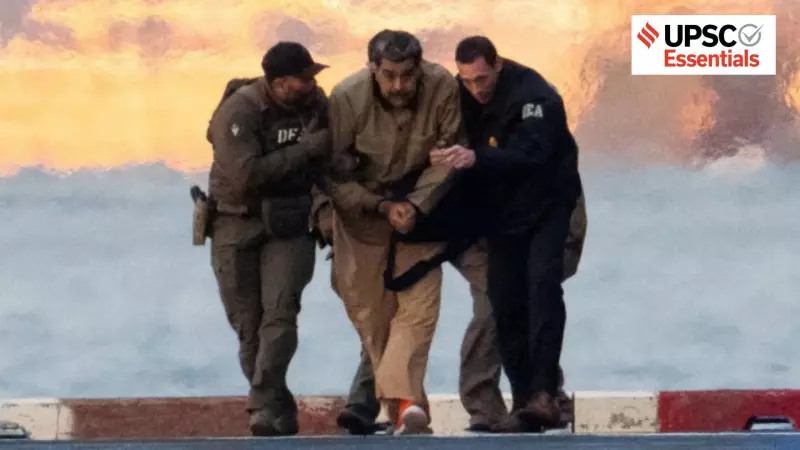
The recent US military operation in Venezuela, resulting in the capture of President Nicolás Maduro on charges including 'narcotics terrorism', has thrown a harsh spotlight on the global illegal drug supply chain and the dangerous phenomenon of state-enabled trafficking. This development offers critical lessons for India, which finds itself grappling with an escalating narcotics threat, particularly from synthetic drugs, and its complex implications for national security.
Venezuela: A Cautionary Tale of State Capture by Cartels
Beyond the debate on the legality of US intervention, Venezuela's trajectory serves as a stark warning. Analysts point out that the country's descent from a transit route to a so-called 'gangster state' was a systematic process. State institutions, including ports, financial systems, and diplomatic channels, were gradually co-opted to facilitate large-scale narcotics trafficking by networks like the alleged 'Cartel of the Suns'.
This nexus between political power, military elites, and transnational cartels demonstrates how drug economies become entrenched when they exploit regulatory loopholes within state infrastructure. For India, this lesson is crucial, as its own regulatory challenges are magnified by its precarious geography.
India is strategically wedged between the world's two largest opium-producing regions: the 'Golden Crescent' (Afghanistan, Pakistan, Iran) to the west and the 'Golden Triangle' (Myanmar, Laos, Thailand) to the east. This positioning inherently embeds the nation within some of the planet's most prolific narcotics trafficking corridors.
Synthetic Storm: How Fentanyl and New Drugs Redefine India's Threat Landscape
The nature of the narcotics threat has undergone a fundamental shift with the rise of synthetic drugs. The 2025 US Annual Threat Assessment notably identified India, after China, as a key source for 'fentanyl precursor chemicals and pill-pressing equipment'.
Fentanyl, a potent synthetic opioid, is a primary driver of the US overdose epidemic. Cases like the US Department of Justice indicting executives of a Hyderabad-based pharmaceutical firm for allegedly supplying precursors like N-BOC-4-piperidone to Mexican cartels underscore India's vulnerability. India began emerging as a hub for illicit production and export around early 2018, as China tightened its chemical controls under international pressure.
The statistics are alarming. The International Narcotics Control Board's 2023 report states that 40% of the global opiate-consuming population resides in South Asia, with India as the region's primary market. Indian law enforcement seized narcotics worth approximately ₹25,330 crore in 2024, a 55% increase from the previous year, driven largely by synthetic drugs, cocaine, and misused pharmaceuticals.
Specific seizures saw dramatic jumps: cocaine from 292 kg (2023) to 1,426 kg (2024), mephedrone from 688 kg to 3,391 kg, and methamphetamine from 34 quintals to 80 quintals.
Beyond Health: Narcotics as a National Security and Financial Menace
The threat extends far beyond public health. Drug trade revenues are increasingly channeled to finance terrorism, procure illegal arms, and fund human trafficking. The western border region, particularly Punjab, exemplifies this convergence, where, as per a UNODC report, ammunition smuggling from Pakistan is often funded by drug profits.
Similarly, insurgent groups in Afghanistan and Myanmar exploit the narcotics economies in their regions, creating a vicious cycle of narcotics-funded militancy. The financial infrastructure of this trade has also evolved. Private institutions have been implicated in laundering drug money, while cryptocurrency and darknet markets have complicated enforcement.
The Directorate of Revenue Intelligence has flagged a rise in using crypto transactions, especially USDT tokens, to camouflage payments and launder drug proceeds, effectively replacing traditional hawala networks. The Smuggling in India 2024–25 report confirms that such methods help traffickers evade regulatory scrutiny.
Charting a Multi-Stakeholder Path Forward for India
Indian authorities have initiated responses, such as the Narcotics Control Bureau's issuance of Unique Registration Numbers (URN) for companies handling 18 new precursor chemicals under the Regulation of Controlled Substances. However, a broader, multi-stakeholder approach is essential.
Key measures could include:
- Implementing stricter oversight of the chemical and pharmaceutical industries.
- Reviewing the Narcotic Drugs and Psychotropic Substances Act, 1985, to better control precursor chemicals and production methods.
- Emulating China's 2019 approach of class-wide control over fentanyl analogues and precursors, alongside stringent 'Know Your Customer' protocols.
- Enhancing international cooperation by leveraging platforms like the International Operation on NPS Incident Communication System (IONICS) and Precursor Incident Communication System (PICS) for data sharing.
Technological investment is also critical. Initiatives like the Punjab government's deployment of counter-drone systems are positive steps. Advanced surveillance technologies—underwater radar, drones, and AI-assisted monitoring—are indispensable for bolstering the Border Security Force's capacity to intercept trafficking and enable efficient confiscations.
The US action in Venezuela is a distant event, but the shadows it casts reach India's borders and its internal security architecture. Addressing the convergent threats of synthetic drugs, terror financing, and digital-age trafficking requires a vigilant, integrated, and technologically adept national strategy.