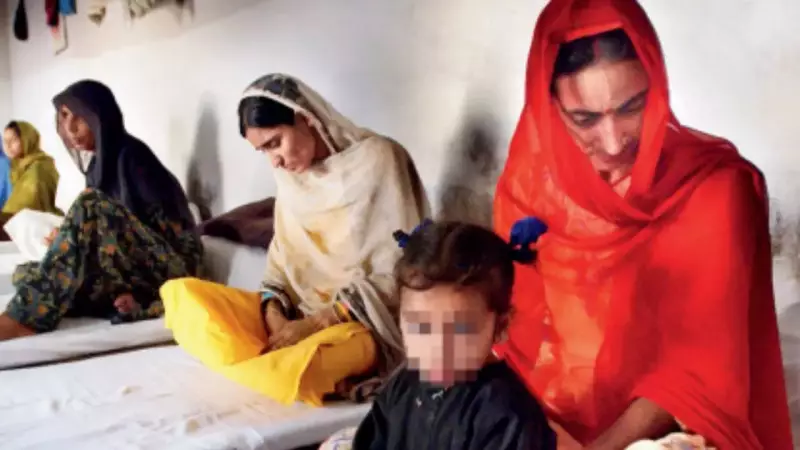
A quiet, confused woman arrested in a police raid three years ago had transformed into a hardened, cynical undertrial by the time advocate Sunita Salsingikar met her again in a Maharashtra prison. This stark change in Rose, a 32-year-old sex worker, mirrors a disturbing national trend: the number of women in Indian prisons is growing at an alarming rate, far outpacing the growth of the general population.
Soaring Numbers and a System Under Strain
According to the sixth World Female Imprisonment List released by the Institute for Crime and Justice Policy Research (ICPR), the count of women in Indian prisons—including both undertrials and convicts—has shot up from 9,089 in 2000 to 23,772 in 2022. This represents a staggering 162% surge over two decades, while India's population grew by only about 30% in the same period. This places India sixth globally in female incarceration, after the US, China, Brazil, Russia, and Thailand.
While women constitute only 4% of India's total prison population of 5.7 lakh, the sharp upward trend raises urgent questions about crime patterns, policing, and the lack of gender-responsive legal and correctional systems.

Why Are More Women Behind Bars?
Experts point to a confluence of factors driving this increase. A significant issue is the harsh handling of non-violent offences, often fueled by social stigma. "In a lot of cases, non-violent offences such as sex work are dealt with more harshly than serious offences because there is a lot of social stigma involved," says prison reforms lawyer Apurva Vivek, founder of Hashiya SocioLegal Centre for Women.
Vivek cites an example from Ranchi where young girls, arrested for soliciting clients to pay college fees, faced a media trial and a collapse of family support, while the men using their services faced no accountability.
The changing nature of women's involvement in crime, especially in urban areas, is another factor. "In cities like Mumbai, women are seen in organised crime, drug-related offences, cheating or human trafficking, etc. But in these types of crime, there would typically be a male accomplice," notes Professor Vijay Raghavan of TISS's Centre for Criminology and Justice.
Critically, procedural failures and a tightening bail regime are trapping women for long periods. Most women inmates are undertrials. Studies, like one by Prayas in Maharashtra (2016-19), show that those arrested for small, poverty-driven crimes can languish for months due to an inability to access or pay for legal aid. Social activist Ravindra Vaidya observes that the judiciary, once more liberal with bail for women, is now rejecting more applications, contributing to the growing undertrial population.
Additionally, a crackdown on illegal immigration has led to a rise in foreign national women prisoners, particularly from Bangladesh.
Small Population, Glaring Gaps in Care and Infrastructure
The system is ill-equipped to handle the distinct needs of women, especially mothers. Infrastructure is cramped, and there is a severe shortage of counsellors, trained social workers, and adequate medical services. "There is a lack of empathy, both at the level of institutions and the society, which refuse to look beyond the criminality of prisoners," Vivek states.
Incarceration amplifies trauma, with studies showing suicide rates in Indian prisons nearly doubling between 2001 and 2019. Women separated from their children are at heightened risk. While initiatives like starting ICDS Anganwadis in some Maharashtra prisons for inmates' children are positive steps, they are far from widespread.
The Path to Reform: Dignity and Alternatives
The ICPR data underscores large gaps in legal aid, sentencing, and prison infrastructure. Experts argue that reform must start by acknowledging women's specific vulnerabilities. "Women form a very small percentage of the prison population. That has unfortunately translated into fewer rehabilitation and skill-building efforts for them. For many, prison becomes their only home," says Vivek.

She stresses the need for interdepartmental coordination to create transitional shelter homes, asserting that "Dignity after prison should be as much a priority as justice inside it." There is a strong call for exploring alternatives to incarceration for non-serious offences, such as open prisons, community service, and bail reforms tailored for women.
For advocate Salsingikar, who witnessed Rose's transformation, one solution stands out: fast-track courts for women. "You can give them washing machines and sewing kits inside the jail, but what they really want is to just get out of it," she concludes, highlighting the fundamental need for swift justice to prevent the system from hardening those it aims to reform.