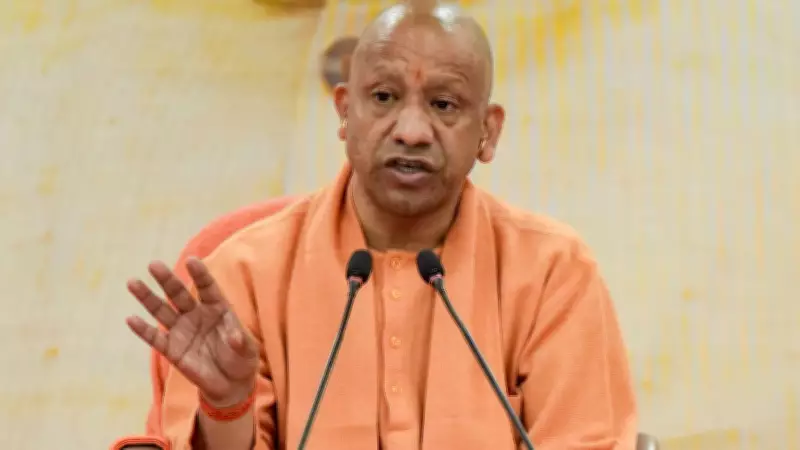
Uttar Pradesh Chief Minister Yogi Adityanath has robustly defended the state police's use of force in encounters, posing a pointed rhetorical question: 'Should cops take the bullet and not fire back?' His remarks come in the wake of significant judicial scrutiny, following the Allahabad High Court's recent expression of concern over what it described as a rising trend of such incidents.
CM's Firm Stance on Police Action
Addressing attendees at the 'Uttar Pradesh Pharma Conclave 1.0' in Lucknow, CM Adityanath articulated a clear justification for police actions. 'People often comment, why did the police fire a bullet? But if the police do not fire, should the police themselves take the bullet?' he stated, emphasizing the perceived necessity of force in confrontational situations.
He elaborated further, asserting that criminals who resort to gunfire must be met with an equivalent response. 'Both cannot happen at the same time. If a criminal has the freedom to open fire, then we have also given pistols to the police so that they can confront them,' the Chief Minister explained. He highlighted that police training is specifically designed to handle such volatile scenarios and to communicate with offenders 'in the language he understands.'
Claims of Improved Law and Order
Linking this assertive policing approach to broader outcomes, CM Adityanath claimed tangible results for public safety. 'And when that language has been used, you would have seen that over the past nine years there has been no talk of disturbance of peace anywhere,' he declared. He pointed to the absence of riots, goon-led extortion, and general lawlessness as evidence of the strategy's effectiveness.
While acknowledging an intent to operate within legal boundaries, the CM noted practical challenges. 'We did try to act within the framework of the law. But many times, as you would also understand, if the person in front is not afraid of the law, then bringing them within the ambit of the law and making them understand the language of the law becomes an immediate and pressing situation,' he added, suggesting that extraordinary circumstances sometimes demand decisive action.
Judicial Concerns and Criticism
This defense follows closely on the heels of critical observations from the Allahabad High Court. Last week, the court took cognizance of incidents where suspects were shot in the leg by police, stating that such encounters had 'become a routine feature' in Uttar Pradesh.
The bench of Justice Arun Kumar Singh Deshwal expressed serious reservations, indicating that these actions might sometimes be motivated by a desire to 'please senior officers or to teach a lesson to the accused.' The court underscored a fundamental legal principle, noting, 'This Court is frequently confronted with cases where, even in matters involving petty offences such as theft, the police indiscriminately resort to firing by projecting the incident as a police encounter… Such conduct is wholly impermissible, as the power to punish lies exclusively within the domain of the Courts and not with the police…'
Broader Context: Pharma Conclave and Investments
The Chief Minister's comments were made during a significant economic event. The Uttar Pradesh Pharma Conclave, inaugurated by CM Adityanath, also served as a platform for announcing substantial industrial commitments. State officials confirmed the signing of memorandums of understanding (MoUs) with pharmaceutical companies, cumulatively worth Rs 10,000 crore.
Addressing investors at the conclave, the CM assured them of a supportive business environment. He pledged the state government's firm backing, guaranteeing zero political interference, transparent policies, and time-bound incentive disbursement to foster growth and investment in the sector.
The juxtaposition of these two narratives—one on stringent law enforcement and the other on economic development—highlights the multifaceted governance approach being promoted in Uttar Pradesh under the current administration.