

Major Maoist Surrender in Bastar Delivers Severe Blow to Insurgency
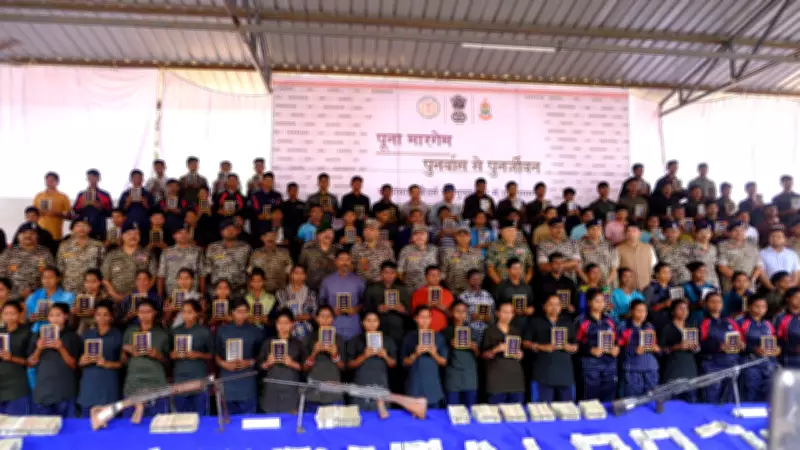
In a landmark event for counter-insurgency operations, a large group of 108 Maoist cadres, collectively carrying a cash reward of Rs 3.29 crore, surrendered in Bastar, Chhattisgarh, on Wednesday. This mass surrender, conducted under the state's "Puna Margem – rehabilitation to rejuvenation" campaign, represents a critical numerical and symbolic victory for security agencies, simultaneously weakening the insurgency's cadre base, weapons pipeline, and financial resources.
Surrender Details and Hierarchy Impact
The surrendering cadres were linked to the Dandakaranya Special Zonal Committee (DKSZC), a key Maoist operational unit in the region. The group included 44 women and functionaries from multiple layers of the Maoist hierarchy, ranging from five divisional committee members to area and platoon-level operatives. They laid down 101 weapons during the ceremony held at the Police Coordination Centre in Jagdalpur.
Security officials emphasized the timing's significance, with only 20 days remaining until the March 31 deadline to eliminate Maoists nationwide. A security officer stated, "This surrender will encourage remaining armed cadres and those in hiding to realize that non-violence is non-negotiable. All Maoists must give up arms and return home for a safe life."

Weapons and Financial Recoveries
Bastar Range Inspector General of Police P Sundarraj reported that based on intelligence from the surrendering cadres, security forces recovered 101 weapons from Maoist dumps across Bastar. The arsenal included:
- AK-47 rifles
- INSAS rifles
- SLRs (Self-Loading Rifles)
- LMGs (Light Machine Guns)
- .303 rifles
- BGL (Bomb Grenade Launchers)
This recovery directly targeted the armed capability of the DKSZC, long considered the backbone of Maoist operations in south Chhattisgarh.
In addition to weapons, authorities seized Rs 3.61 crore in cash and 1 kg of gold, valued at approximately Rs 1.64 crore. Officials described this as the largest cash haul ever recovered from a single Naxal dump in India's history of anti-Naxal operations.
Prominent Cadres and Regional Spread
Among the senior cadres who surrendered were Rahul Telam, Pandru Kovasi, Jhitru Oyam from west Bastar, Ramdhar alias Biru from east Bastar, Mallesh from north Bastar, Muchaki of PLGA Battalion number 1, and Kosa Mandavi from the Andhra-Odisha border zone. These individuals represent the mid-level grid crucial for Maoist recruitment, mobilization, and survival.
The weapon recoveries were distributed across multiple districts:
- 49 weapons from Narayanpur
- 24 from Bastar
- 12 from Sukma
- 9 from Bijapur
- 5 from Dantewada
- 2 from Kanker
Rehabilitation and Broader Implications
During the surrender ceremony, cadres were handed roses and copies of the Indian Constitution, with tribal community representatives welcoming them. This gesture aimed to affirm their acceptance and appreciation for choosing to surrender.
Officials highlighted that the "twin track of security pressure plus rehabilitation outreach" is beginning to hollow out the insurgency from within. Under Chhattisgarh's Naxal surrender, victim relief, and rehabilitation policy, surrendered cadres will receive financial aid, skill development, housing, education, and livelihood support.
According to police data, approximately 2,714 Maoist cadres have renounced violence in Chhattisgarh over the last 26 months, including 2,625 in Bastar division alone between January 1, 2024, and March 9, 2026. A CRPF officer noted that while Bastar's conflict was historically measured in encounters and body counts, a new metric of surrender and rehabilitation is now gaining ground.






