

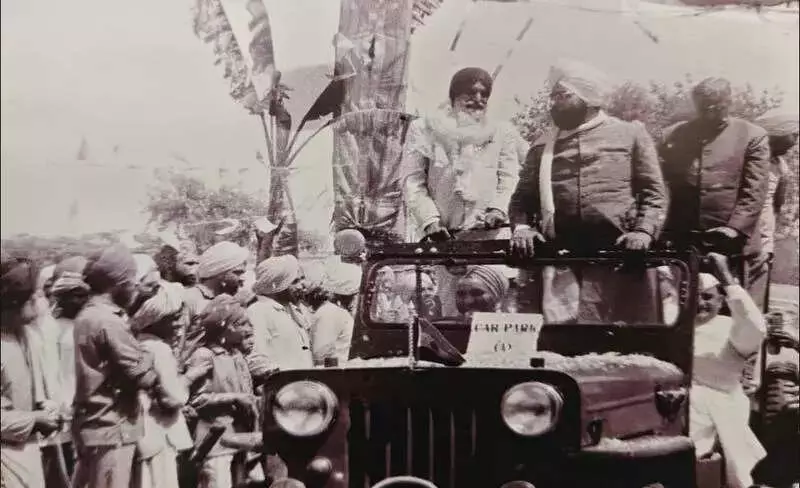
In a remarkable display of unity that contrasts sharply with today's political climate, historical rivals set aside deep differences in 1975 to honor a shared spiritual legacy. This occurred during the 300th anniversary of the martyrdom of the ninth Sikh Guru, Guru Tegh Bahadur, a time when the nation was under the Emergency and the Akali Dal was actively agitating against it.
A Gathering Defying Political Divides
Despite the prevailing Emergency and the fact that several senior Akali leaders were imprisoned, a grand religious function was successfully organized at Delhi's Ramlila Maidan. Prime Minister Indira Gandhi addressed this massive gathering, sharing the stage with senior Akali and other Sikh leaders. This unprecedented coordination involved the Shiromani Gurdwara Parbandhak Committee (SGPC), the Akali Dal, the Punjab government led by Chief Minister Giani Zail Singh, and the Central Government.
Former MP Tarlochan Singh, a confidant of the then CM Giani Zail Singh, recalled the extraordinary effort. He highlighted that the SGPC initiated a procession from Anandpur Sahib to Delhi. This procession included leading figures like CM Giani Zail Singh, Akali leaders Sant Harchand Singh Longowal and Surjit Singh Barnala, SGPC leader Kirpal Singh Chaksherewala, and Inderjit Singh, the then chairman of Punjab and Sind Bank.

"After night stopovers, the procession reached Delhi. I even accompanied Sant Longowal in his vehicle," Tarlochan Singh recounted. "Then, a joint function was held at Ramlila Maidan where PM Indira Gandhi, Giani Zail Singh, DSGMC president Jaswant Singh Kochhar, Longowal, and other Akali leaders sat together on the stage."
Personal Memories and Bold Speeches
Manjit Singh GK, who attended the function as an adolescent and later became a DSGMC president and SAD leader, shared vivid memories. He recalled Indira Gandhi connecting her lineage to Pandit Kirpa Ram, who led the Kashmiri Pandit delegation to Guru Tegh Bahadur. GK's father, the late Santokh Singh, a top Delhi SAD leader, played a crucial role in organizing the event, despite having strained relations with Punjab-based Akali leaders just months prior.
GK also remembered that at a 1968 martyrdom function at Gurdwara Sis Ganj, Gandhi had announced the transfer of Kotwali land to the gurdwara. This promise saw partial fulfillment in 1975, with the remaining land transferred in 1980.
Another attendee, former DSGMC chief Paramjit Singh Sarna, reached Ramlila Maidan at 5:30 am. He remembered a poignant moment when young Sikhs objected to policemen wearing shoes inside the 'pandal' where the Guru Granth Sahib was placed, leading them to step out. The 'kirtan' was performed by Bhai Dharam Singh Zakhmi. "The discourse he delivered about the Guru and his three disciples' martyrdom brought alive the scene of the torture and their execution. It is still fresh in my mind," Sarna said.
He also revealed that in their speeches, Surjit Singh Barnala and Sant Kartar Singh, the then head of the Damdami Taksal, openly opposed the Emergency right in front of Indira Gandhi. Barnala was arrested shortly after this mega event.
A Precedent of Unity: The 1973 Procession
This 1975 event was not the first instance of such collaboration. In 1973, the Congress government led by CM Giani Zail Singh and the Akalis had come together for a major procession on the newly constructed Guru Gobind Singh Marg in Delhi. Memorial gates were erected along this route, built under the CM's initiative.
While there were significant differences and political considerations, persuasion led both sides to agree. This cooperation created positive memories and credit for all involved. The details of the negotiations between SGPC president Gurcharan Singh Tohra and Zail Singh, in the presence of Sikh intellectuals, are recorded in the book 'Sabat Kadmi Nange Pairi Sidki Safar'. The book is based on Tohra's conversations with the late author Prof Piara Singh Bhogal and edited by activist Malvinder Singh Mali. CM Zail Singh and Tohra led that 1973 procession together in an open jeep.

The 1975 commemoration of Guru Tegh Bahadur's tercentenary martyrdom stands as a powerful historical example where political animosity was temporarily suspended for a higher, unifying purpose, showcasing a rare moment of concord in Punjab's complex religio-political landscape.





