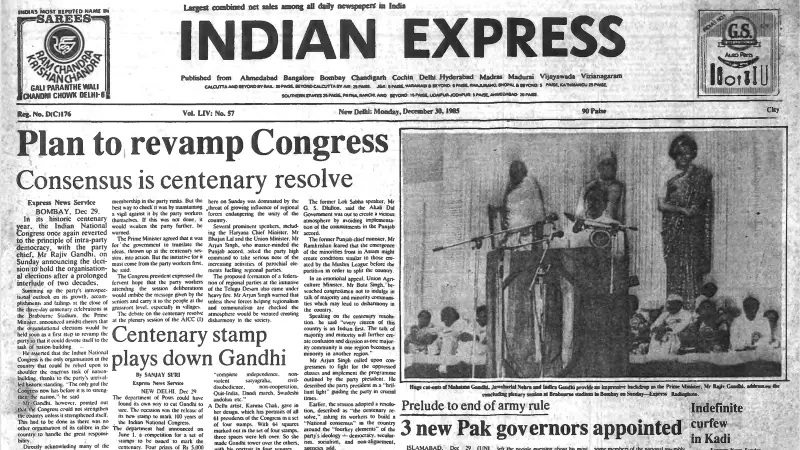
December 30, 1985, was a day of significant political manoeuvres in South Asia and a stark reminder of global Cold War tensions. The front page of The Indian Express from that date captured three major stories: Pakistan's President Zia-ul-Haq preparing for a political transition, the Indian National Congress embarking on internal reform under Rajiv Gandhi, and the United States conducting a massive underground nuclear test as part of its 'Star Wars' initiative.
Zia-ul-Haq's Political Gambit in Pakistan
As Pakistan stood on the brink of ending its longest period of martial law, President General Zia-ul-Haq made key administrative changes. He appointed new governors for three crucial provinces: Punjab, North-West Frontier (now Khyber Pakhtunkhwa), and Baluchistan. This reshuffle was widely seen as a strategic move to consolidate control and manage the impending shift away from direct military rule.
In discussions with members of the national assembly, Zia-ul-Haq signalled his intent to introduce what he termed "undiluted democracy." However, these appointments, made by the military leader himself, cast a shadow over the promised democratic process, indicating that the army's influence would remain potent in the country's governance.

Congress Looks Inward on its Centenary
In India, the ruling Indian National Congress (INC) was engaged in deep introspection during its historic 100th-year celebrations. At a massive gathering at Mumbai's Brabourne Stadium, Prime Minister and party chief Rajiv Gandhi announced a landmark decision to hold organisational elections. This move aimed to revive intra-party democracy after a gap of nearly two decades.
Summing up the party's reflections on its century-long journey, its achievements, and its shortcomings, Gandhi stated that these elections were the first step in a comprehensive revamp of the grand old party. The announcement was met with loud cheers from party workers, signalling a desire for renewal.
In a related event, the Department of Posts marked the Congress centenary by releasing commemorative stamps. The department had earlier run a design competition, offering four prizes of Rs 5,000 and ten consolation prizes of Rs 500 each. Participants were encouraged to create designs that highlighted the "mass movement nature" of the INC.
A 'Star Wars' Bomb Shakes the Desert
Across the globe, the Cold War's technological arms race manifested in a dramatic underground test. US officials detonated a buried hydrogen bomb in the Nevada desert, a key experiment for the Strategic Defense Initiative (SDI), popularly known as "Star Wars."
The device, code-named Goldstone, was exploded 1,800 feet beneath the surface. It packed a terrifying explosive yield equivalent to 150,000 tons of TNT. This power was approximately ten times the force of the atomic bomb dropped on Hiroshima in 1945, highlighting the escalating scale of nuclear weapons development under the guise of defensive systems.
Legacy of a Pivotal Day
The events of December 30, 1985, reveal a world in flux. In Pakistan, Zia's governor appointments set the stage for a controlled democratic facade, while in India, the Congress party's attempt at internal democracy sought to reconnect with its roots. Simultaneously, the colossal nuclear test in Nevada served as a grim benchmark for the era's geopolitical strife, where the quest for ultimate defence mechanisms fuelled ever-more-powerful instruments of destruction.