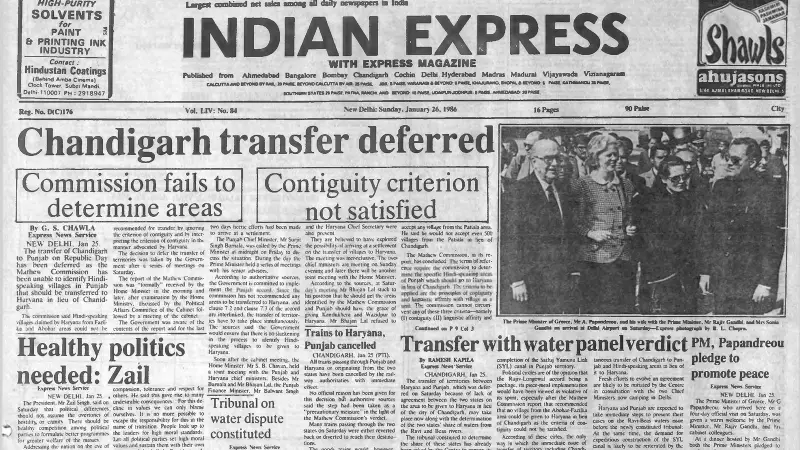
January 26, 1986: A Republic Day Marked by Political Deferral and Diplomatic Gestures
On this historic Republic Day in 1986, a significant political development unfolded as the much-anticipated transfer of Chandigarh to Punjab was officially deferred. This decision came in the wake of the Mathew Commission's inability to resolve a critical aspect of the longstanding territorial dispute between Punjab and Haryana.
The Chandigarh Impasse and Commission Findings
The Mathew Commission, tasked with facilitating the transfer, found itself at a deadlock over identifying Hindi-speaking villages in Punjab that could be transferred to Haryana as compensation for Chandigarh. According to official reports, the commission explicitly stated that it could not recommend the transfer of villages from the Fazilka and Abohar areas, as claimed by Haryana. This refusal was based on the principle of not ignoring the criterion of contiguity, nor interpreting it in the manner advocated by the Haryana government.
Government sources emphasized that there would be no slackening in efforts to address this complex issue, indicating ongoing commitment to finding a resolution despite the setback.

Scattered Violence in Punjab Casts a Shadow
Amidst the political deliberations, Punjab witnessed a series of unsettling incidents that added to the day's tensions. Official reports received in Chandigarh detailed five separate occurrences across the state, including two Punjab police personnel being deprived of their service revolvers, a state-owned bus set ablaze, and two shopkeepers falling victim to looting. These events underscored the volatile security situation in the region during this period.
Republic Day Celebrations and Diplomatic Engagements
On a more positive note, the Republic Day celebrations in New Delhi were graced by the presence of Greek Prime Minister Andreas Papandreou, who arrived on a four-day official visit. He received a warm welcome from Prime Minister Rajiv Gandhi and his cabinet colleagues, highlighting India's diplomatic outreach.
At a dinner hosted by Gandhi, both leaders pledged to collaborate in promoting international peace and strengthening bilateral ties. Papandreou, accompanied by his wife Margaret Papandreou, was honored as the chief guest at the Republic Day parade, symbolizing the day's spirit of unity and global cooperation.
Establishment of a Water Dispute Tribunal
In another significant move, the government announced the constitution of a tribunal to adjudicate the water dispute between Punjab and Haryana. Headed by Justice V Balakrishna Eradi, a sitting Supreme Court judge, the tribunal was mandated to submit its report within six months. This step reflected the administration's proactive approach to resolving inter-state conflicts through legal and institutional mechanisms.
This Republic Day in 1986 thus encapsulated a mix of deferred political promises, regional unrest, high-profile diplomacy, and judicial interventions, painting a vivid picture of India's multifaceted challenges and aspirations during that era.