January 23, 1986: A Day of Historic Verdicts and National Turmoil
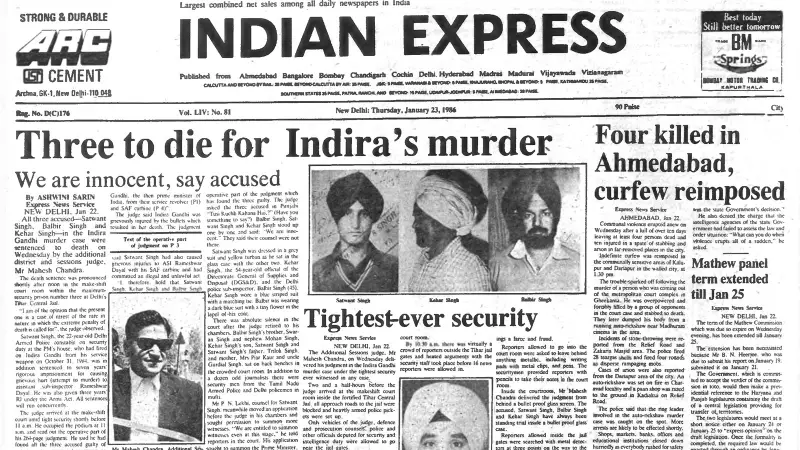
Forty years ago, on January 23, 1986, India witnessed a pivotal moment in its judicial and political history, as captured on the front page of The Indian Express. This date marked the sentencing of the assassins of former Prime Minister Indira Gandhi, alongside escalating communal tensions and political unrest across the nation.
Death Sentences Pronounced in Tihar Jail for Indira Gandhi's Assassins
In a makeshift courtroom within Tihar Jail, additional district and sessions judge Mahesh Chandra delivered a landmark verdict. All three accused in the Indira Gandhi murder case—Satwant Singh, Balbir Singh, and Kehar Singh—were sentenced to death. Satwant Singh, a 22-year-old Delhi Armed Police constable stationed at the Prime Minister's residence who fired the fatal shots, received an additional seven years of rigorous imprisonment for causing grievous hurt to ASI Rameshwar Dayal in an attempt to murder. This ruling brought a somber closure to one of India's most traumatic political assassinations, underscoring the gravity of the crime that shook the nation in 1984.
Communal Violence Erupts Anew in Ahmedabad
Simultaneously, communal violence flared up in Ahmedabad after a brief lull of over ten days. The unrest resulted in at least four fatalities and ten injuries due to widespread stabbing and arson incidents across distant parts of the city. Authorities responded by reimposing an indefinite curfew in the communally sensitive areas of Kalupur and Dariapur. The violence was triggered by the murder of an individual exiting the metropolitan court complex in Gheekanta, highlighting the fragile peace in the region and the persistent challenges of communal harmony.

Political Arrests and Agitation in Chandigarh
In Chandigarh, political tensions escalated as Devi Lal, the chief of the four-party Haryana Sangharsh Samiti, was among approximately 500 opposition workers and leaders arrested. This crackdown occurred on the eve of a planned "rasta roko" (road blockade) stir and a one-day bandh (shutdown). The agitation was jointly called by the Lok Dal, Bharatiya Janata Party, Congress (S), and Janata Party to protest alleged injustices against Haryana under the Punjab accord, reflecting the deep-seated regional and political disputes of the era.
Post-Election Violence Claims Lives in Assam
Assam was rocked by one of the worst incidents of post-election violence, where a mother and daughter, described as relatives of former chief minister Hiteshwar Saikia, were killed in an armed attack in Guwahati. Golak Rajbonshi, leader of the Congress-I legislature party, reported a series of attacks on party supporters and workers since the election. He alleged that Asom Gana Parishad (AGP) supporters were involved in many of these cases, based on written complaints, pointing to the volatile political climate and ethnic tensions in the northeastern state.
This day in 1986 encapsulates a period of intense national reckoning, from judicial accountability in a high-profile assassination case to widespread social and political strife, illustrating the complex tapestry of India's democratic journey.