January 16, 1986: A Day of Legal Closure and Global Diplomacy
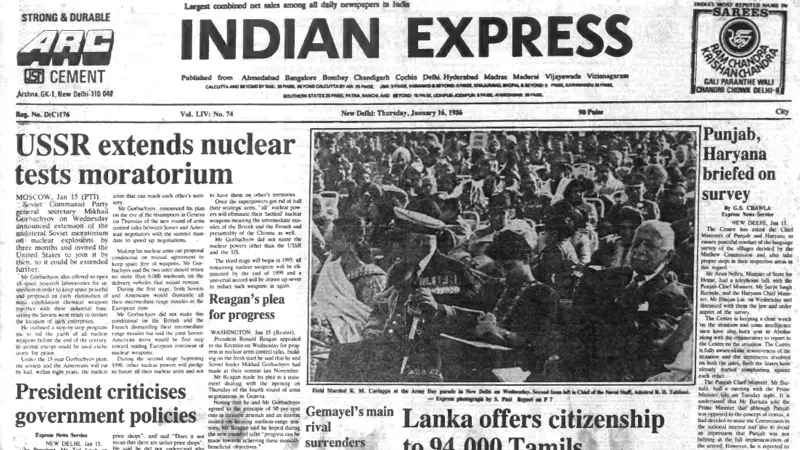
Forty years ago today, The Indian Express front page captured pivotal moments in Indian justice and international relations. The newspaper's edition from January 16, 1986, reported significant developments that shaped both national and global narratives.
Indira Gandhi Assassination Trial Reaches Its Conclusion
The lengthy trial concerning the assassination of former Prime Minister Indira Gandhi finally reached its end phase. After eight months of proceedings, Special Judge Mahesh Chandra reserved his judgment for January 22, 1986.
Defense counsel P N Lekhi completed his final arguments in the high-profile case. Three accused individuals faced serious charges in this trial. Satwant Singh, the surviving alleged assassin, stood accused alongside Balbir Singh and Kebar Singh. The charges against them included murder and criminal conspiracy.

The court considered severe penalties for the accused. If found guilty, the three men faced possible death sentences or life imprisonment terms. This trial represented a crucial moment in India's legal history following the tragic events of 1984.
Soviet Union Announces Nuclear Moratorium Extension
On the international stage, Soviet leader Mikhail Gorbachev made important announcements regarding nuclear weapons. The General Secretary of the Soviet Communist Party declared a three-month extension of his country's unilateral moratorium on nuclear explosions.
Gorbachev extended an invitation to the United States to join this moratorium. He suggested that if America participated, the nuclear freeze could continue beyond the initial three-month period. The Soviet leader also proposed opening all space research laboratories for international inspection. This move aimed to maintain peaceful uses of outer space.
Additionally, Gorbachev advocated for the early elimination of chemical weapons designed for mass destruction. He called for dismantling not just the weapons themselves but also their industrial manufacturing bases.
Reagan Appeals for Progress in Arms Control Talks
American President Ronald Reagan responded to these developments with his own diplomatic efforts. Reagan appealed directly to the Kremlin for meaningful progress in nuclear arms control negotiations. He referenced the positive foundation established during his November summit meeting with Gorbachev.
The President made his plea through an official statement. This statement coincided with the opening of the fourth round of arms negotiations in Geneva. Reagan emphasized building upon what he described as a fresh start in US-Soviet relations.
Haryana Chief Minister Seeks CRPF Deployment
Domestically, Haryana Chief Minister Bhajan Lal raised concerns about census operations in his state. Lal urgently requested central government assistance to ensure fair census proceedings in Kandu Khera village.
The Chief Minister specifically asked the Centre to deploy Central Reserve Police Force personnel to the area. He alleged that Punjab Police officers were terrorizing the Hindi-speaking population in the village. According to Lal's statements to journalists, Punjab Police had already abducted three or four individuals from the community.
Bhajan Lal expressed further concerns about ongoing house searches in the village. He worried that additional persons might be taken away by police forces. The Chief Minister noted that senior civil and police officers from Punjab were currently camping in Kandu Khera village.
These events from January 16, 1986, illustrate how legal proceedings, international diplomacy, and regional tensions intersected on a single day in India's history. The front page of The Indian Express documented these developments as they unfolded, providing readers with comprehensive coverage of matters ranging from courtroom drama to global security concerns.