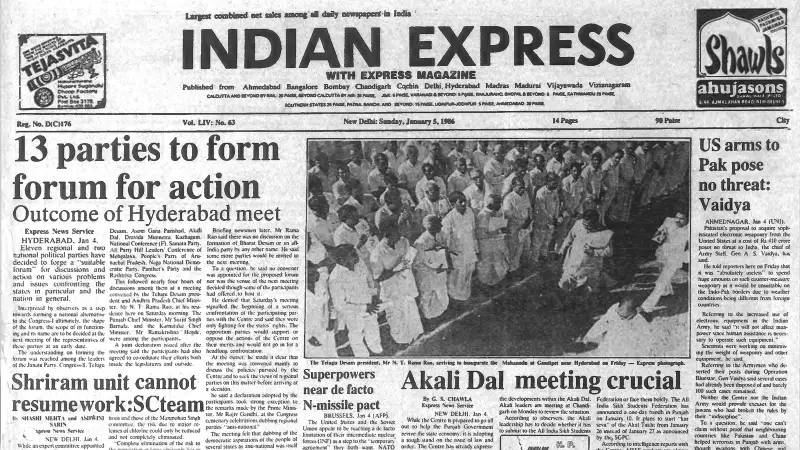
January 5, 1986, marked a significant day in India's political landscape, with major developments on the domestic and international fronts. The front page of The Indian Express from that day reported on a crucial opposition unity move, a hardening central stance on Punjab, and a potential superpower agreement.
Opposition Parties Move Towards a National Alternative
In a major political development, eleven regional and two national parties agreed to create a unified platform. This "suitable forum" was intended for discussion and coordinated action on critical issues facing both the states and the nation. Political observers of the time interpreted this move as a foundational step towards building a viable national alternative to the dominant Congress-I party.
The understanding was reached among leaders from the Janata Party, Congress-S, Akali Dal, and the DMK, among others. The precise shape, scope, and even the name of this new opposition forum were left to be finalized at a subsequent meeting, indicating the preliminary yet serious nature of the talks.
Centre Adopts Tough Stance on Punjab Violence
While the central government expressed readiness to assist the Punjab government in reviving the state's economy, it adopted an uncompromising position on law and order. The Centre had conveyed its serious concern to Punjab Chief Minister Surjit Singh Barnala regarding the persistent violence in the state.
A high-level review of the Punjab situation was imminent. There was a growing perception in New Delhi that the Akali Dal ministry led by Barnala was struggling to control the deteriorating situation. This period was a critical phase in the long-standing Punjab crisis.
Global Dynamics: Superpowers and Regional Security
On the international stage, the United States and the Soviet Union appeared to be moving towards a de facto limitation of their short-range nuclear forces in Europe. This was seen as a step towards a "temporary agreement" both superpowers desired, focusing on limiting the number of nuclear missile launchers on European soil.
Closer to home, Army Chief General A S Vaidya commented on regional security. He stated that Pakistan's proposal to acquire advanced electronic weaponry from the US, worth Rs 410 crore, did not pose a direct threat to India. However, when questioned about foreign support for terrorism in Punjab, he noted that while weapons with Chinese and Pakistani markings were recovered from the Golden Temple after Operation Bluestar, one could not claim without concrete proof that these countries directly aided the terrorists.
This day in 1986, therefore, captured a nation at a complex crossroads—grappling with internal political realignment, severe regional conflict, and navigating a world still defined by Cold War tensions.