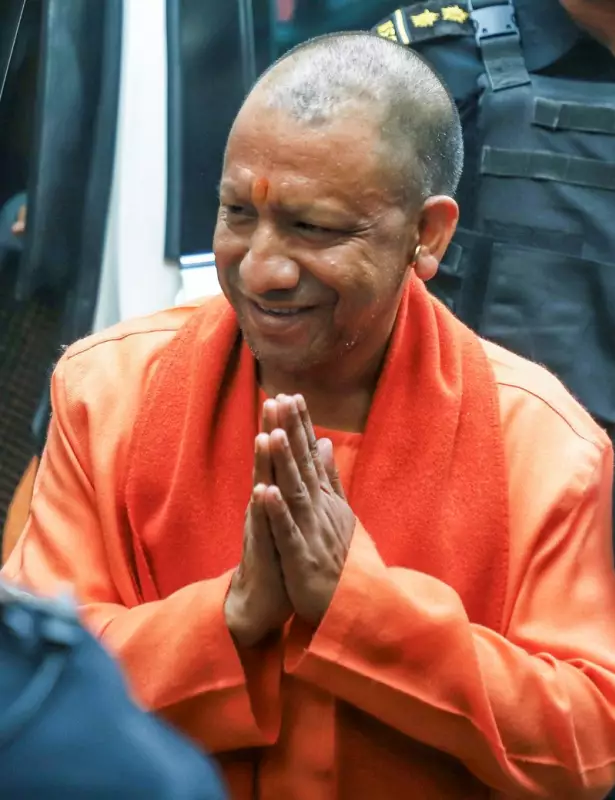
Uttar Pradesh Chief Minister Yogi Adityanath has made a significant political statement, holding India's first Prime Minister, Jawaharlal Nehru, responsible for creating a lasting controversy around Jammu and Kashmir. He contrasted this historical stance with the actions of the current government under Prime Minister Narendra Modi, which he credited with decisively resolving the matter.
Historical Blame and a Contrast in Leadership
Speaking at a public event, Adityanath delivered a pointed critique of Nehru's handling of the Kashmir situation post-Independence. He asserted that the decisions taken during Nehru's tenure laid the foundation for decades of dispute and instability in the region. The Chief Minister emphasized that these historical choices had long-term negative consequences for national unity.
Adityanath specifically highlighted that the issue persisted for over 70 years, implying a failure of successive governments to address the core problem inherited from the Nehru era. His comments are part of a broader narrative often promoted by the Bharatiya Janata Party (BJP), which seeks to reassess the legacies of Congress party leaders from the Nehru-Gandhi family.

The Modi Government's Decisive Action in 2019
In sharp contrast to his criticism of the past, Adityanath lavished praise on Prime Minister Narendra Modi's administration for its bold move on August 5, 2019. On that date, the Government of India revoked the special status granted to Jammu and Kashmir under Article 370 of the Constitution and bifurcated the state into two Union Territories: Jammu & Kashmir, and Ladakh.
Adityanath framed this decision as a momentous and corrective step. He stated that this action by the Modi government had successfully and permanently integrated Jammu and Kashmir into the Indian Union, putting an end to the era of ambiguity and controversy. According to him, this move ensured that the region's development could now proceed on par with the rest of the nation, free from the shackles of its previous legal status.
Political Context and Broader Implications
The Chief Minister's remarks are not made in isolation. They come amidst an ongoing political discourse where the current BJP-led government frequently contrasts its policy decisions with those of previous Congress-led regimes. The abrogation of Article 370 remains a central pillar of the BJP's political agenda and a key talking point in its campaigns.
By crediting Prime Minister Modi with solving a "seven-decade-old problem," Adityanath is reinforcing the party's image as a decisive force in Indian politics. This narrative serves to strengthen the BJP's position on national security and territorial integrity, core issues that resonate with its support base. The statement also indirectly targets the opposition Congress party by linking it to a period of perceived indecision on Kashmir.
The integration of Jammu and Kashmir, as described by Adityanath, is portrayed as the final chapter in a long struggle for complete national unity. His speech underscores a clear political message: that strong, determined leadership is required to rectify historical errors and secure India's future.