AIMIM Transforms from 'Vote Cutter' to Major Political Force in Maharashtra
Nagpur witnessed a dramatic political shift in the recent Maharashtra civic elections. The All India Majlis-e-Ittehadul Muslimeen (AIMIM), led by Asaduddin Owaisi, completely shattered its old image. For years, critics labeled the party as a mere 'vote cutter' or the BJP's B-team. This election proved those labels wrong. AIMIM emerged as the first choice for voters in numerous wards across the state.
A Historic Realignment in Municipal Politics
The results mark a significant realignment in Maharashtra's political landscape. In at least seven municipal corporations, AIMIM has replaced the Congress as the principal challenger to the ruling Bharatiya Janata Party (BJP). The party secured an impressive tally of at least 124 seats statewide. Its strongest performance came from Chhatrapati Sambhajinagar, where it won 33 seats.
AIMIM outperformed several established mainstream parties in these civic body contests. It beat the Shiv Sena (UBT), the Maharashtra Navnirman Sena (MNS), the NCP (SP), and the Vanchit Bahujan Aghadi (VBA) in multiple seats. This demonstrates a clear consolidation of its support base.

Expanding Footprint Across Vidarbha and Beyond
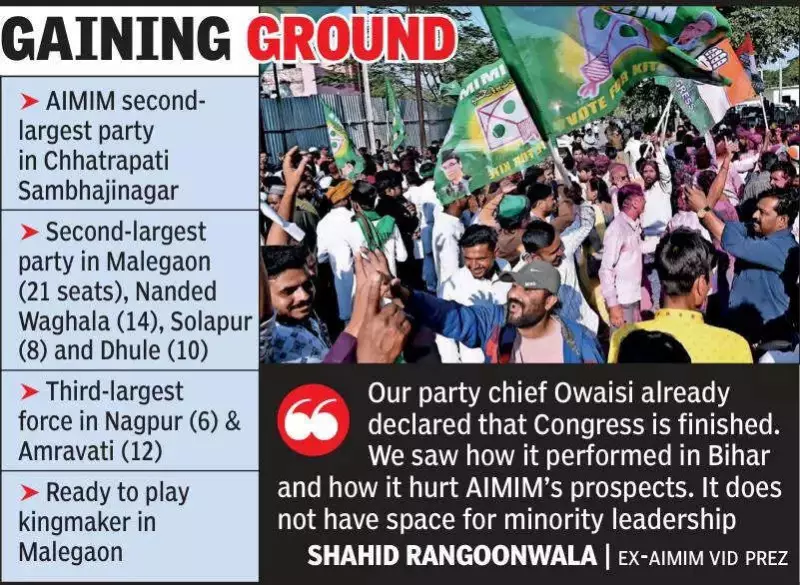
The party's expansion into the Vidarbha region is particularly notable. AIMIM secured 21 seats in this area, marking successful debuts in key cities. It won 6 seats in Nagpur and 1 seat in Chandrapur. This underlines the party's growing influence beyond its traditional strongholds.
AIMIM is now the second-largest party in several important municipal corporations. These include Sambhajinagar, Malegaon (21 seats), Nanded Waghala (14 seats), Solapur (8 seats), and Dhule (10 seats). Furthermore, it holds the position of the third-largest party in Nagpur and Amravati, with 12 seats in the latter. In Malegaon, the party has effectively become the kingmaker. Its political maneuvering will also be crucial in Akola, where no single party achieved a simple majority.
Positioning as the Direct Alternative to BJP
Party office-bearers have wasted no time in framing this victory. They are positioning AIMIM as the direct and credible challenge to the BJP. The leadership explicitly refuses to play second fiddle to the Congress, which was long considered the traditional opposition choice.
Many within the party believe their final seat count could have been even higher. They argue that Congress and other Maha Vikas Aghadi (MVA) parties acted as 'vote cutters' against AIMIM candidates in numerous constituencies.
Close Contests and the 'Vote Cutter' Dynamic
Several close races illustrate this point vividly. In Nagpur's Ashi Nagar zone, Prabhag 3A, AIMIM candidate Reshma Nandagawli secured 9,806 votes. She still lost to BJP's Kiran Manpiya, who got 11,201 votes. Congress and MVA parties are seen to have taken a sizeable chunk of votes that might have gone to AIMIM. Despite this, the party's other three candidates in the area defeated both BJP and Shiv Sena rivals.
A similar story unfolded in Nagpur's Nehru Nagar zone, Prabhag 30. AIMIM candidates fought closely against BJP in two seats and against Congress in one seat. Their winning margins were significantly narrowed due to the presence of Congress and MVA candidates.
In Chandrapur, the party contested four seats but managed only one victory. That win came against a Congress candidate. In Prabhag 10B, AIMIM's Fauziya Anjum secured around 2,000 votes, losing to Congress's Sofiya Khan, who polled over 4,000 votes. MVA parties collectively took away more than 2,700 votes in that ward.
The pattern repeated in Akola. AIMIM fielded 31 candidates but won just two seats. In Prabhag 31, losing candidate Sakawat Sheikh got 3,559 votes. Congress candidate Noor Ahfaz Shaikh polled 3,844 votes, while BJP's Sharad Tunkar won with over 6,000 votes. The presence of the Congress candidate clearly impacted AIMIM's margin.

Leadership Declares Congress 'Finished'
Shahid Rangoonwala, the former AIMIM Vidarbha president, was blunt in his assessment. "Our party chief Owaisi already declared that Congress is finished," he stated. He pointed to the party's performance in Bihar and how it hurt AIMIM's prospects there. Rangoonwala argued that Congress no longer has space for strong minority leadership and that its voter base is shrinking rapidly.
He cited the example of Chhatrapati Sambhajinagar, where Congress managed to win just a single seat in the civic elections. "Congress is now incapable of defeating BJP on its own," he asserted. Rangoonwala revealed that AIMIM had previously taken the initiative to form alliances with Congress to stop the BJP but received no positive response.
"AIMIM Maharashtra chief Imtiyaz Jaleel gave us the liberty to forge local anti-BJP tie-ups," he explained. This strategy bore fruit in some areas. For instance, an alliance with the Indian Union Muslim League (IUML) helped both parties, with the IUML winning four seats in Prabhag 3.
Analysts See a Lasting Impact
Political observers are taking note of this seismic shift. Senior journalist and analyst Sameer Ishaque provided his insight. "The party's performance indicates it has strengthened its hold in Muslim and Dalit-dominated urban areas of the state," he said.
Ishaque emphasized that this is being viewed as a direct challenge to the Congress and the NCP (Sharad Pawar faction). AIMIM has successfully made inroads into their traditional vote banks. The success in these civic polls is not an isolated event. Analysts believe it could significantly influence political equations in the upcoming Maharashtra assembly elections and the next Lok Sabha polls.
The narrative has flipped. AIMIM is no longer on the sidelines. It has firmly positioned itself as a central player in Maharashtra's complex political arena, ready to challenge the BJP directly.