Civil Aviation Ministry Provides Detailed Account of Ajit Pawar's Fatal Plane Crash
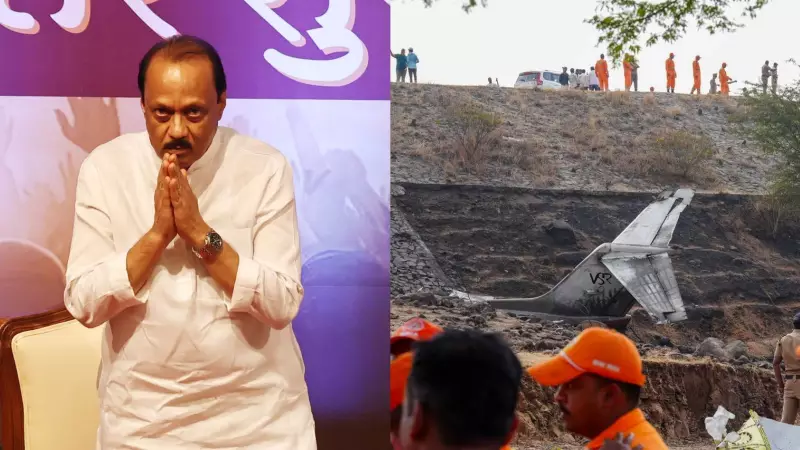
Maharashtra Deputy Chief Minister Ajit Pawar tragically lost his life in a devastating plane crash in Baramati on Wednesday, January 28, 2026. The Nationalist Congress Party leader was en route to conduct four crucial political rallies ahead of the upcoming Zilla Parishad elections when the fatal accident occurred.
The Fatal Flight and Its Occupants
According to an official government release from the Civil Aviation Ministry, there were five individuals aboard the ill-fated aircraft, including two crew members. Among the passengers was Deputy Chief Minister Shri Ajit Pawar. The ministry confirmed with solemn finality that all occupants sustained fatal injuries in the crash, leaving no survivors from the tragic incident.
Baramati's Uncontrolled Airfield: A Critical Factor
The destination airfield in Baramati presents unique operational challenges as it functions as an uncontrolled airfield. This means that air traffic information and coordination are not managed by conventional air traffic controllers but are instead provided by instructors and pilots from the flying training organizations based at Baramati. This unconventional arrangement creates distinct operational parameters that pilots must navigate.

Minute-by-Minute Account of the Crash Sequence
Based on statements from the person manning the Air Traffic Control at the time, the Civil Aviation Ministry has reconstructed the sequence of events leading to the fatal crash:
- Initial Contact (0818 IST): Aircraft VI-SSK first established communication with Baramati airfield.
- Approach Clearance: The aircraft made its next call at 30 nautical miles inbound to Baramati, having been released by Pune approach control. The crew received clearance to descend under Visual Meteorological Conditions at the pilot's discretion.
- Weather Inquiry: The crew specifically inquired about wind conditions and visibility, receiving information that winds were calm with visibility approximately 3,000 meters.
- First Approach Attempt: The aircraft reported being on final approach for Runway 11 but indicated the runway was not in sight, prompting them to initiate a go-around procedure.
- Second Approach: After the go-around, the aircraft again reported being on final approach for Runway 11. When asked to confirm runway visibility, the crew responded, "runway is currently not in sight, will call when runway is in sight."
- Visibility Confirmation: Mere seconds later, the crew reported that the runway was now in sight.
- Landing Clearance (0843 IST): The aircraft received clearance to land on Runway 11, but notably failed to provide the required readback of the landing clearance.
- The Crash (0844 IST): Air Traffic Control observed flames around the threshold of Runway 11, immediately triggering emergency response protocols.
The aircraft wreckage was subsequently located on the left side of the runway, positioned abeam the threshold of Runway 11. Emergency services rushed to the crash site immediately upon detection of the flames.
Investigation Underway by Aircraft Accident Investigation Bureau
The Aircraft Accident Investigation Bureau has assumed control of the investigation into this tragic incident. The Director General of AAIB is personally traveling to the accident site to oversee the investigation process. The ministry has committed to sharing further details as they become available through the ongoing investigation.
This investigation adds to the AAIB's current caseload, which includes the recent Air India accident in Ahmedabad where a London-bound plane crashed minutes after take-off, resulting in 241 fatalities with only one survivor.
The detailed account provided by the Civil Aviation Ministry offers crucial insights into the final moments of the flight that claimed the life of one of Maharashtra's most prominent political figures, while raising important questions about aviation safety protocols at uncontrolled airfields.