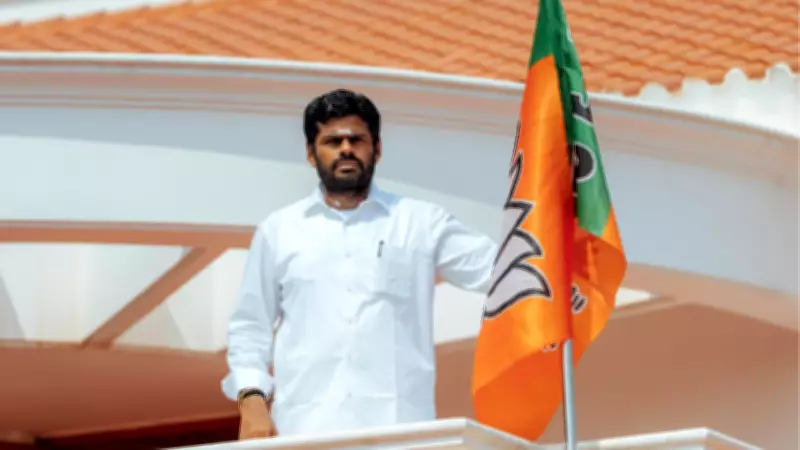
NEW DELHI: Former Tamil Nadu BJP chief K Annamalai, in a rare dissent, has publicly opposed the CBSE's revised three-language mandate, triggering fresh political chatter in Tamil Nadu. Annamalai urged the Union education ministry to withdraw the CBSE notification that made three languages compulsory for Class IX students from the current academic year, saying the abrupt move had "come as a shock to many parents, especially those from Tamil Nadu."
This public dissent has for obvious reasons triggered political chatter far beyond the language debate. And the reason is simple. For years, Annamalai had been among the BJP's most aggressive defenders of the National Education Policy (NEP) and the three-language formula in Tamil Nadu, repeatedly taking on former chief minister MK Stalin and the Dravida Munnetra Kazhagam (DMK) whenever they accused the Centre of attempting "Hindi imposition" in the state. That is what made the recent intervention politically striking.
What Annamalai said
On May 15, the CBSE issued a notification making a third language compulsory for Class IX students from the current academic year, advancing an earlier timeline that proposed implementation from 2029-30. Annamalai objected not to the policy itself, but to the sudden rollout. "This has come as a shock to many parents, especially those from Tamil Nadu," he wrote on X, arguing that forcing students to pick up a new language at short notice would "pressurise children and affect their overall learning outcomes." He also reminded the Centre that the earlier CBSE notification issued in April had clearly stated that the Class IX mandate would begin only from the academic year 2029-30. "I request the Ministry of Education to immediately roll back this notification and honour its previous commitment," he said.

The sharpness of the statement stood out because only weeks ago, Annamalai had welcomed the broader three-language framework for Class VI students, saying it would expose children to India's "diverse literary landscape." That contrast signals that the statement might not merely be a policy disagreement, but a calibrated political signal to the BJP leadership in Delhi.
Why the statement matters
Language remains the most politically combustible issue in Tamil Nadu. The anti-Hindi agitations of the 1960s reshaped the state's political landscape and helped Dravidian parties establish decades-long dominance. Even today, any move perceived as linguistic imposition quickly acquires emotional and political overtones. For decades, parties such as the DMK and the All India Anna Dravida Munnetra Kazhagam (AIADMK) have portrayed the BJP as a "north Indian" party attempting to dilute Tamil linguistic identity. The BJP has struggled to shake off that perception.
Annamalai's political project since entering Tamil Nadu politics has partly been an attempt to localise the BJP's image — to make it appear less like an external ideological force and more like a party capable of speaking the language of Tamil identity and regional aspiration. That balancing act becomes difficult on issues such as the NEP and the three-language policy. If the BJP aggressively pushes the policy, it risks reinforcing the DMK's "Hindi imposition" charge. Annamalai's latest intervention appears to be an attempt to walk that middle line. Notably, he did not reject multilingual learning or the NEP. Instead, he framed the issue around implementation, student pressure and administrative overreach. That distinction is politically important because it allows him to oppose the Centre's handling of the issue without appearing ideologically rebellious.

The perfect timing?
The timing of the dissent is equally significant in case of the firebrand politician. The BJP's poor performance in the 2026 Tamil Nadu assembly elections has intensified debate within the party over strategy, leadership and alliances in the state. The BJP won just one seat, while ally AIADMK secured 47. Even before the elections, AIADMK chief Edappadi K Palaniswami had reportedly asked the BJP to sideline Annamalai in order to forge an alliance. Meanwhile, BJP had removed Annamalai as state president, a decision widely viewed as a way to revive ties with the AIADMK. Union home minister Amit Shah at that time had said that "Annamalai's organisational skills will be leveraged within party's national framework." Later, BJP also decided not to field Annamalai in the assembly elections. The state president Nainar Nagendra had said the "decision was taken by the party high command." On the other hand, Annamalai had reportedly expressed discomfort over the BJP aligning too closely with the AIADMK. His argument, according to party insiders, was that the BJP needed to grow as an independent force in Tamil Nadu instead of permanently operating as a junior partner to Dravidian majors. That internal debate did not disappear after the elections.
In recent days, reports suggested that the Tamil Nadu BJP's organisational structure and leadership were under review following the NDA's disappointing performance. Discussions were said to be under way in Delhi regarding possible restructuring and future leadership roles. Against that backdrop, Annamalai publicly choosing a politically sensitive issue like language to assert himself appears unlikely to be accidental.
A preemptive political move
The intervention may also have been aimed at denying the opposition an easy political opening. Had the BJP defended the CBSE notification without qualification, the DMK and actor-politician Vijay's Tamilaga Vettri Kazhagam would likely have seized upon it to revive the BJP's "Hindi imposition" image. Language remains one of the few issues capable of quickly consolidating anti-BJP sentiment across sections in Tamil Nadu. By criticising the circular himself, Annamalai effectively blunted that line of attack before it gathered momentum. The framing of his objection also appeared carefully designed to appeal to urban middle-class families whose children study in CBSE schools — a demographic the BJP has increasingly targeted in Tamil Nadu.
More regional space within BJP?
Annamalai's statement may ultimately reflect a larger reality confronting the BJP in Tamil Nadu. The party's national rise has largely been built on message discipline and ideological consistency. Tamil Nadu, however, has historically resisted centralised political narratives, especially on language and identity. For the BJP to grow in the state, its leaders may increasingly need space to publicly tailor positions to regional sentiment. Annamalai's dissent suggests that at least some within the party recognise this. For Annamalai personally, the episode also helps reinforce an image he has carefully cultivated — that of a Tamil leader first, BJP leader second. At a time when the Tamil Nadu BJP's future leadership structure is under discussion, Annamalai's intervention may serve as a reminder to the party high command that he remains one of the BJP's few leaders capable of shaping political narratives in the state and which is probably why the leadership should listen to what he has to say.