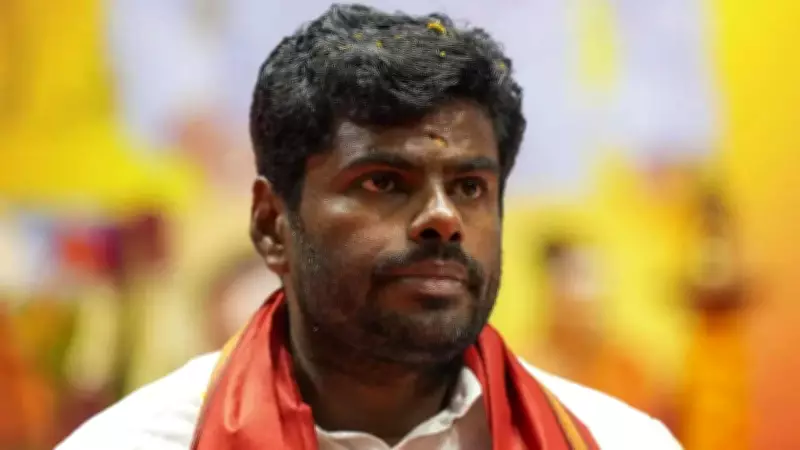
K Annamalai's resignation from the Bharatiya Janata Party (BJP) has capped months of dissent and his diminishing role within the organisation, raising fresh questions about the saffron party's ambitions in Tamil Nadu and the political future of one of its most recognisable faces in the state.
The former IPS officer, widely known as 'Singham' for his aggressive political style, joined the BJP in 2020 and rose rapidly through the ranks. He was appointed president of the party's Tamil Nadu unit in 2021 and played a key role in expanding its presence in the state.
Under his leadership, the BJP achieved its strongest Lok Sabha performance in Tamil Nadu in 2024, securing a vote share of 11.4 per cent, a significant improvement from 3.7 per cent in the 2019 general election. However, that momentum faded in the run-up to the 2026 assembly elections.

The BJP's U-turn on AIADMK
Annamalai's 2024 padayatra significantly boosted the BJP's visibility in Tamil Nadu and helped the party achieve its highest-ever vote share in a Lok Sabha election in the state. The BJP secured 11.38 per cent of the vote in 2024, a dramatic improvement from 3.62 per cent in 2019. Yet the electoral breakthrough remained incomplete, as the party failed to win a single parliamentary seat for the second consecutive election. The contrast was particularly striking given that the BJP had managed to secure one Lok Sabha seat in 2014 with a much lower vote share of 5.56 per cent.
Annamalai's BJP timeline
Throughout his tenure, Annamalai distinguished himself through relentless attacks on Dravidian politics and the leaders who shaped it. His criticism was not restricted to political opponents. Even while the BJP was aligned with the AIADMK, he repeatedly targeted figures from the ally's camp, creating friction within the alliance and widening differences between the two parties. As the relationship deteriorated, sections within the BJP began reassessing the political costs and benefits of maintaining distance from the AIADMK. Eventually, the party leadership chose to revive the alliance ahead of the 2026 Assembly elections despite strong reservations from Annamalai. The decision marked a turning point in his political journey within the BJP. Soon afterwards, he was replaced as state unit chief, a move widely seen as an attempt to smooth relations with the AIADMK and accommodate the realities of coalition politics in Tamil Nadu.
The fallout
Annamalai was replaced by Nainar Nagendra as state president and gradually found himself excluded from important organisational responsibilities, which was reportedly a part of the BJP's pre-poll deal with the rival AIADMK to wrest power from the ruling DMK. The alliance was seen as a major point of disagreement as Annamalai reportedly favoured building the party independently at the grassroots level rather than relying on coalition politics. The emergence of Vijay's TVK as a significant political force further complicated the BJP's position in the state. Consequently, Annamalai stepped down as election in-charge for six constituencies and was later left out of the party's legislative assembly election management committee. He also did not contest the assembly elections, though he maintained that the decision was his own. 'When I did not express any interest in contesting, how could the leadership allocate me a ticket? If I had decided to contest, it wouldn't have mattered which constituency I could have contested from anywhere. I am grateful to the BJP leadership for respecting my decision and giving me the opportunity to campaign in support of the NDA alliance candidates,' he had said.
The first public sign of a fallout
For years, K Annamalai largely stayed aligned with the BJP's central leadership. That changed when he publicly criticised the Union education ministry's decision to advance the implementation of a three-language requirement for Class IX students. The intervention was widely seen as his first open disagreement with the party line and fuelled speculation that tensions within the BJP had reached a tipping point. The controversy began after the CBSE issued a notification on May 15 directing affiliated schools to introduce a third compulsory language for Class IX students from the current academic year, years ahead of the previously envisaged 2029-30 timeline.

How Annamalai was pushed to edge
Reacting to the decision, Annamalai wrote on X, 'This has come as a shock to many parents, especially those from Tamil Nadu, as their children have already selected a language of choice in class VI. The revised notification now mandates that class IX students learn three languages, two of which must be native to India, with effect from July 1, 2026. Expecting a class IX student to learn a new language at such short notice will only pressurise children and affect their overall learning outcomes.' The remarks carried significance because language remains one of the most politically sensitive issues in Tamil Nadu. By openly expressing reservations over the policy, Annamalai appeared willing to distance himself from the BJP's official position and signal a more independent political identity. His eventual resignation, therefore, did not emerge out of nowhere. The seeds of discontent had been visible for some time, particularly after the BJP leadership opted to revive its alliance with the AIADMK ahead of the 2026 Assembly elections. Annamalai had consistently argued for building the party as an independent force in Tamil Nadu rather than relying on established regional allies.
A political experiment cut short
Annamalai's departure leaves the BJP confronting a difficult question about whether it abandoned a long-term strategy before it had the chance to mature. Although he did not lead the party into either of the Assembly elections that coincided with his rise, Annamalai became the most recognisable BJP face in Tamil Nadu and helped inject energy into a cadre that had long struggled for visibility. He took over as state president after the 2021 Assembly election, in which the BJP won four seats with a vote share of 2.62 per cent. By the time the 2026 election concluded, Annamalai was no longer at the helm. The party's tally had dropped to a single seat, while its vote share saw only a marginal rise to 2.99 per cent. With his exit, the BJP now faces the possibility of losing local leaders and grassroots workers who were drawn to the party largely because of his leadership.
The election outcome also highlighted another reality. The overwhelming support received by Vijay and his party TVK suggested that Tamil Nadu voters were open to embracing a fresh political alternative. The BJP had attempted a similar experiment through Annamalai, but ultimately chose a different route. While Annamalai never commanded the kind of mass appeal enjoyed by Vijay, the former IPS officer, popularly known as 'Singham', had built a strong following among younger voters. His direct style and aggressive campaigning gave the BJP a visibility it had rarely enjoyed in the state.
In hindsight, the party appears to have faced a difficult choice between continuing with Annamalai's grassroots expansion strategy and joining hands with the AIADMK to create a wider anti-DMK alliance. It eventually chose the latter. That decision may have strengthened the alliance arithmetic, but it also narrowed Annamalai's room for manoeuvre. Ironically, the combative approach that made him one of the BJP's most effective campaigners in Tamil Nadu may also have contributed to his exit. For both Annamalai and the BJP, the question of what might have been is likely to linger for some time.
What's next for Singham
His resignation came amid reports that he is preparing to launch a new political party with a Tamil-first and more centrist political approach. While the official announcement is expected, the possibility of a new outfit with independent political space beyond the BJP has cast a foreboding shadow over the saffron party's ambitions. His departure also leaves the party facing the challenge of replacing a leader whose confrontational style and direct messaging resonated strongly with sections of younger voters. For the BJP, the exit raises concerns not only about leadership in Tamil Nadu but also about its long-term strategy in a state where it continues to struggle for political relevance.
About the Author: The TOI News Desk comprises a dedicated and tireless team of journalists who operate around the clock to deliver the most current and comprehensive news and updates to the readers of The Times of India worldwide. With an unwavering commitment to excellence in journalism, our team is at the forefront of gathering, verifying, and presenting breaking news, in-depth analysis, and insightful reports on a wide range of topics. The TOI News Desk is your trusted source for staying informed and connected to the ever-evolving global landscape, ensuring that our readers are equipped with the latest developments that matter most.