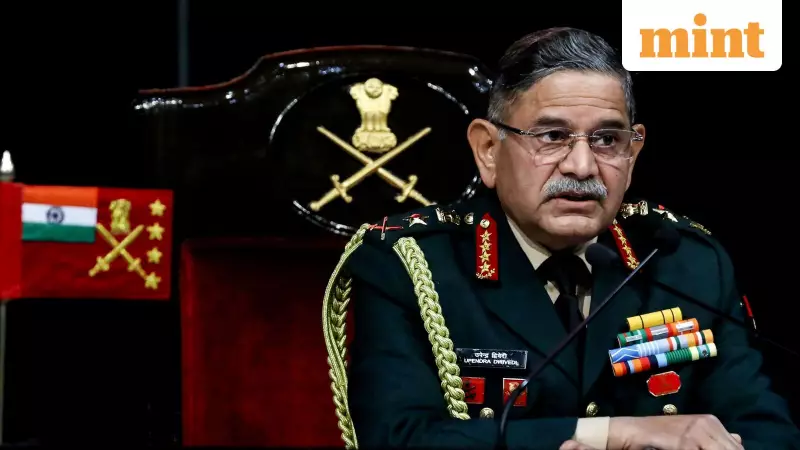
Chief of Army Staff General Upendra Dwivedi made a significant statement on Tuesday. He confirmed that no discussions about nuclear warfare took place between the Directors General of Military Operations of India and Pakistan during Operation Sindoor.
Clear Denial of Nuclear Rhetoric
During a press conference held in New Delhi, journalists asked the army chief about potential nuclear threats from Pakistan during the 2025 conflict. General Dwivedi answered with a firm negative. He stated that the talks between officials of both countries contained no nuclear rhetoric.
"As far as nuclear rhetoric is concerned, I would like to say that there was no discussion on nuclear in the DGMO talks," Dwivedi told the ANI news agency. He further explained that any nuclear talk came from political figures or the local public in Pakistan, not from the military establishment. "I have no indication that anything of that sort came from the military," he emphasized.

Expanding Conventional Warfare Space
The army chief elaborated on India's strategic approach during the conflict. He rejected the notion that modern conflicts jump directly from sub-conventional warfare to the nuclear domain. Instead, India deliberately created more room for conventional military operations on the ground.
"When we talk about our role in this, it was stated that the space for conventional operations is shrinking," Dwivedi noted. "But this time, the action we took... was taken because we expanded the conventional space."
He specifically highlighted military actions in Jammu and Kashmir. The army's response, including precise firing, addressed threats and eliminated approximately 100 personnel associated with Pakistan. This demonstrated the effective use of expanded conventional capabilities.
Preparedness for Ground Operations
General Dwivedi also pointed to the army's rapid mobilisation during the 88-hour operation. "The army's mobilisation to expand the conventional space was such that if Pakistan made any mistake, we were fully prepared to launch ground operations," he stated. This readiness underscored India's strategic posture and deterrence.
Casualty Figures and Drone Warfare
The army chief provided specific details about casualties. He referenced a list mistakenly released by Pakistan around August 13 or 14, 2025, which named about 150 individuals. After analysis, India assessed that roughly 100 of those people had been killed.
"About 100 people, according to our assessment, had been killed in the firing along the Line of Control or in the IB J&K sector," Dwivedi confirmed.
He also discussed the evolving role of technology in warfare. Drones were already important, but Operation Sindoor significantly accelerated their use. "After Operation Sindoor, this aspect received a major acceleration. We were already monitoring this organisation," he said, indicating enhanced surveillance and strike capabilities.
Background on Operation Sindoor
Operation Sindoor marked India's most significant military action inside Pakistani territory in over fifty years. Conducted in May 2025, it was a joint operation involving the Indian Army, Navy, and Air Force.
The operation mobilised troops and assets, utilizing special precision munitions. Media reports indicate the strikes targeted locations in Pakistan to achieve two primary objectives:
- Avenge the victims of the Pahalgam terror attack in Kashmir.
- Eliminate leaders of Jaish-e-Mohammed (JeM) and Lashkar-e-Taiba (LeT) involved in planning and executing terrorist attacks against India.
This operation demonstrated a calibrated, conventional military response to cross-border terrorism, firmly within the expanded operational space discussed by the army chief.