

Wealth and Criminal Records Dominate Bengal's First Phase Election Landscape
A comprehensive analysis of candidates contesting the first phase of the West Bengal Assembly elections has revealed startling figures about wealth distribution and criminal backgrounds among political contenders. The study, conducted by the Association for Democratic Reforms (ADR) and West Bengal Election Watch (WBEW), examined affidavits from 1,475 out of 1,478 total candidates, with three affidavits containing technical glitches.
Significant Proportion of Crorepati Candidates Emerges
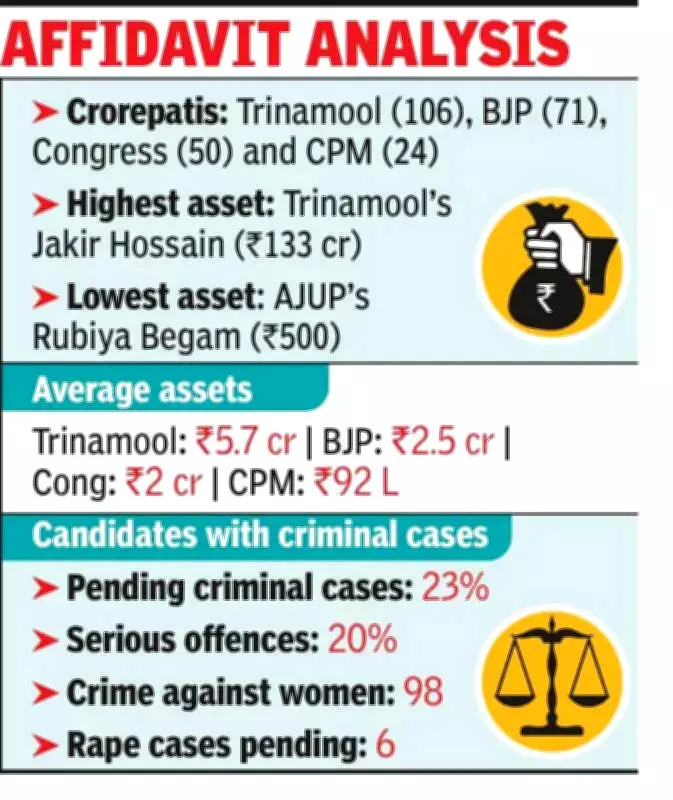
Nearly one-fifth of all candidates in the first phase are crorepatis, with Trinamool Congress contenders dominating the wealthiest categories. The data shows that 228 candidates possess assets ranging between Rs 1 crore and Rs 5 crore, while 46 candidates have assets valued between Rs 5 crore and Rs 10 crore. An additional 35 candidates boast assets exceeding Rs 10 crore.
Leading the wealth rankings is Trinamool's Jangipur candidate Jakir Hossain, with declared assets surpassing Rs 133 crore. He is followed closely by fellow Trinamool contender Goutam Mishra from Barjora, who has assets worth Rs 105 crore, and Kabi Datta from Durgapur West with Rs 72 crore in declared wealth.

Party-Wise Wealth Distribution Patterns
The analysis reveals distinct patterns in wealth distribution across political parties. Among Trinamool Congress candidates, 106 individuals qualify as crorepatis, with the party's average candidate asset value standing at Rs 5.7 crore. The Bharatiya Janata Party (BJP) follows with 71 crorepati candidates and an average asset value of Rs 2.5 crore per candidate.
Congress candidates show 50 crorepatis among their ranks with an average asset value of Rs 2 crore, while Communist Party of India (Marxist) candidates have an average asset value slightly above Rs 92 lakh, with 24 crorepati candidates. These figures highlight significant disparities in financial resources among competing political entities.
Alarming Criminal Case Statistics Surface
The ADR-WBEW report uncovers concerning statistics regarding criminal cases among election candidates. Overall, 23% of all contenders have pending criminal cases against them, with 20% facing charges for serious offences. Among BJP candidates, 106 out of 152 have pending criminal cases, including 96 with records of serious offences.
Trinamool Congress shows 63 candidates with pending criminal cases out of 148 contenders, with 48 facing serious charges. The Indian Secular Front (ISF) presents particularly troubling numbers, with six out of eight candidates having serious offences including rape, murder, and attempted murder charges.
Ujjaini Halim, state coordinator of ADR and WBEW, emphasized that 66 out of the 152 constituencies feature three candidates each with criminal records. Disturbingly, six candidates across various parties face pending rape cases, raising serious questions about candidate selection processes.
Notable Cases of Minimal Assets
At the opposite end of the wealth spectrum, the analysis identifies candidates with remarkably modest declared assets. The poorest candidate is Rubiya Begam of the Aam Janata Unnayan Party (AJUP), contesting from Durgapur East with declared assets of just Rs 500. She is followed by Sushrita Saren of SUCI from Midnapore with Rs 700 in assets, and Jashoda Barman from Jalpaiguri with Rs 924 in declared wealth.
These figures present a stark contrast to the crorepati candidates and highlight the diverse economic backgrounds of individuals participating in the democratic process. The presence of candidates with minimal assets alongside multi-crorepati contenders underscores the complex socioeconomic dynamics at play in West Bengal's electoral landscape.
Broader Implications for Democratic Processes
The comprehensive data reveals that 66 constituencies feature three candidates each with criminal records, creating concerning scenarios for voters. Additionally, among the nine AIMIM contenders, six have pending criminal cases with four facing serious charges. Both candidates from WB Socialist Party and SDPI have serious offences against them, according to the affidavit analysis.

These findings raise important questions about the quality of political representation and the criteria used by parties during candidate selection. The significant presence of wealthy candidates alongside those with criminal backgrounds suggests complex factors influencing candidate nominations beyond mere electoral viability.
The ADR-WBEW analysis provides voters with crucial information to make informed decisions while highlighting systemic issues in India's electoral democracy. As West Bengal approaches this critical phase of elections, these revelations about candidate backgrounds and financial resources will likely influence public discourse and voting patterns across the state.





