

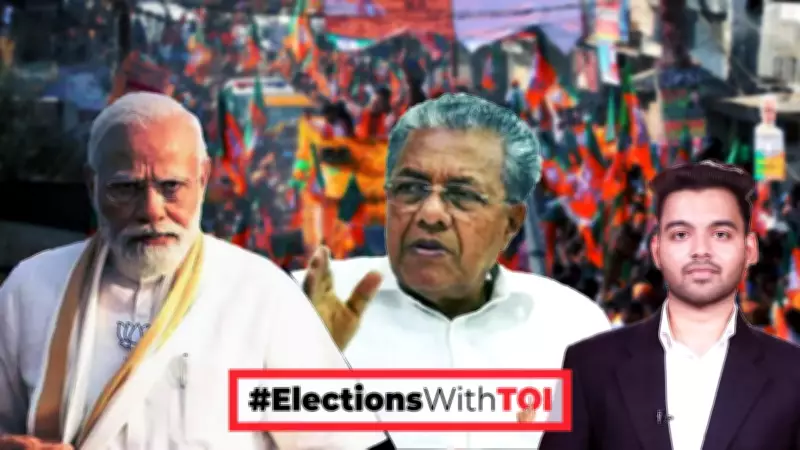
Decoding BJP's Final Frontier: The Kerala Electoral Puzzle
Kerala has consistently been labeled the Bharatiya Janata Party's (BJP) "final frontier" in Indian politics. While the party has achieved significant expansion across most regions of India, it continues to face substantial challenges in establishing a robust and enduring foothold in this southern state. The upcoming 2026 Assembly elections present a critical juncture for the BJP as it attempts to navigate Kerala's unique political landscape.
The Historical Bipolar Contest and BJP's Entry
For decades, Kerala's political arena has been dominated by a bipolar contest between the Left Democratic Front (LDF) and the United Democratic Front (UDF). This entrenched dynamic has historically limited the space for a third force, making the BJP's electoral ambitions particularly daunting. However, recent trends indicate a gradual shift, with the party making incremental gains in select constituencies.
Emerging Strongholds: Thrissur, Nemom, and Palakkad
The BJP has identified several key constituencies as potential strongholds in its Kerala strategy. Thrissur has emerged as a focal point, with the party leveraging local issues and candidate appeal. Nemom remains a significant seat, having previously elected a BJP legislator, symbolizing a breakthrough. Palakkad is another critical area where demographic and socio-economic factors are being carefully analyzed for electoral gains.

Critical Issues Shaping the Electoral Battle
Voter sentiment in Kerala is influenced by a range of pressing issues. Governance efficiency, economic management, employment generation, and the implementation of welfare schemes are at the forefront of public discourse. The BJP's campaign is expected to emphasize these areas, contrasting its national policies with the state's performance under incumbent administrations.
Demographic Complexities: Hindu, Muslim, and Christian Communities
Kerala's social composition adds a layer of complexity to the electoral equation. The state's population includes significant Hindu, Muslim, and Christian communities, each with distinct political leanings and priorities. The BJP faces the challenge of expanding its appeal beyond its traditional Hindu base to include broader sections of society, necessitating nuanced outreach and policy positioning.
The Challenge of Expanding Beyond the Traditional Base
A primary obstacle for the BJP in Kerala is the need to transcend its conventional support base. This involves addressing local concerns, building alliances, and presenting a governance model that resonates with Kerala's development-oriented electorate. The party's ability to craft a compelling narrative that aligns with state-specific aspirations will be crucial in determining its electoral fortunes in 2026.
As the 2026 Assembly elections approach, the BJP's strategy in Kerala will be closely watched. The interplay of constituency-level dynamics, demographic factors, and issue-based campaigning will define whether the party can finally breach this longstanding frontier in Indian politics.






