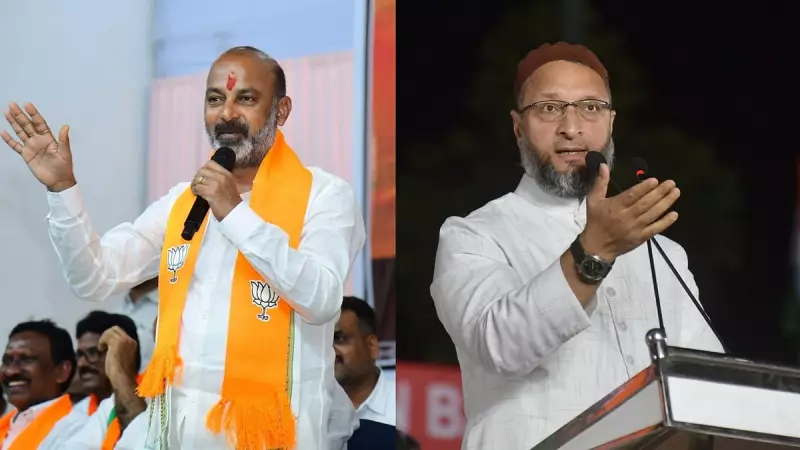
In a sharp political attack, a senior Bharatiya Janata Party (BJP) leader has thrown down a direct challenge to All India Majlis-e-Ittehadul Muslimeen (AIMIM) president Asaduddin Owaisi. Union Minister Bandi Sanjay Kumar has publicly dared Owaisi to appoint a woman who wears the hijab as the chief of his party.
The Core of the Challenge
The provocative statement was made on 11 January 2026. Bandi Sanjay Kumar, a prominent BJP figure, did not mince words while questioning the AIMIM's commitment to gender equality and the empowerment of Muslim women. His challenge cuts to the heart of a long-standing criticism often levelled against the Hyderabad-based party by its opponents.
The union minister went beyond mere rhetoric, levelling a serious allegation. He claimed that within the AIMIM's framework, Muslim women activists who raise their voices and question the party's leadership often face intimidation. According to Kumar, this alleged environment of suppression contradicts the party's public stance on representing the community's interests.

Context and Political Implications
This incident is the latest flashpoint in the ongoing and often heated political discourse in India concerning women's rights, religious identity, and political representation. The hijab, a traditional headscarf worn by many Muslim women, has become a potent symbol in this debate, representing both faith and personal choice for some, while for others, it signifies questions about integration and empowerment.
By specifically challenging Owaisi to elevate a hijab-clad woman to the top post, Sanjay Kumar is attempting to frame the narrative around the AIMIM's internal practices. The implication is clear: if the party truly stands for the women of its community, it should demonstrate that faith by placing one in its highest leadership role. The BJP leader's remarks are seen as an effort to put the AIMIM on the defensive regarding its record on women's leadership.
Reactions and the Road Ahead
As of now, there has been no official public response from Asaduddin Owaisi or the AIMIM to Bandi Sanjay Kumar's specific challenge. Political observers are keenly watching for a reaction, which is expected to be firm and likely counter the BJP's allegations.
This exchange highlights the intensifying political battles in the lead-up to future elections, where every statement is crafted to appeal to specific voter bases and put rivals in a difficult position. The focus on Muslim women activists and their space within political parties is a significant subplot in India's larger democratic story.
The development underscores several key themes in contemporary Indian politics:
- The use of symbolic gestures and challenges in political rhetoric.
- The ongoing debate about the representation of women, particularly from minority communities, in political leadership.
- The persistent allegations and counter-allegations between national and regional parties regarding their commitment to social justice.
The political fallout from this challenge remains to be seen, but it has undoubtedly added a new layer to the complex relationship between the BJP and the AIMIM.