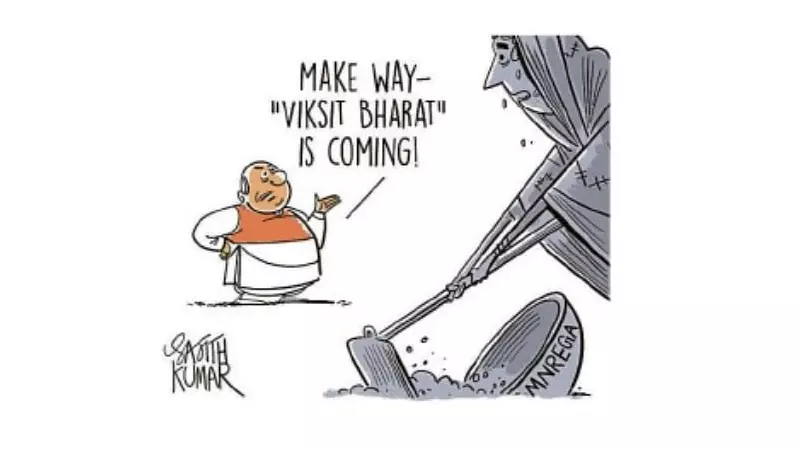
A recent political cartoon published by Deccan Herald has sparked conversation with its pointed visual commentary on the ambitious Viksit Bharat 2047 vision. The illustration serves as a satirical lens, focusing on the perceived dissonance between grand national promises and the everyday challenges faced by citizens.
The Cartoon's Visual Narrative
The cartoon, a staple of editorial commentary, uses symbolic imagery to convey its message. It typically depicts a common citizen, often overwhelmed, juxtaposed against towering, abstract representations of government slogans and future blueprints. The core of its satire lies in highlighting the gap between visionary pronouncements and tangible, on-the-ground progress in areas critical to public welfare.
Elements within such cartoons frequently reference lofty goals set for the year 2047—the centenary of India's independence—while drawing attention to immediate concerns like inflation, unemployment, and infrastructure. The artistic critique suggests that for the 'Developed India' vision to be credible, it must be rooted in actionable steps that improve daily life now, not just in distant future projections.

Context: The Viksit Bharat 2047 Promise
The Viksit Bharat (Developed India) 2047 initiative is a long-term national development framework. It envisions transforming India into a fully developed nation by the time it marks 100 years of freedom. The agenda spans comprehensive economic growth, technological leadership, social welfare, and environmental sustainability.
However, this cartoon falls into a long tradition of political satire that holds power to account. It questions the pace and prioritization of this transformation. By focusing on the citizen's perspective, the artwork implies that development rhetoric can sometimes feel disconnected, urging a more grounded and inclusive approach to nation-building. The humor is sharp, designed not just to entertain but to provoke thought and dialogue among the public.
Reactions and the Role of Editorial Satire
Such cartoons are powerful because they distill complex policy debates into an instantly understandable visual metaphor. They play a crucial role in a healthy democracy, offering critique and fostering public discourse. The reaction to this Deccan Herald cartoon is likely divided, mirroring the broader political spectrum—some may see it as a necessary reality check, while others may view it as cynical towards national ambitions.
Ultimately, the cartoon underscores a vital democratic principle: that grand visions like Viksit Bharat 2047 must continually be measured against the lived experiences of ordinary people. It serves as a reminder that sustainable development requires not just top-down planning but also addressing the pressing needs that define the present. The artist's work, therefore, is less about dismissing the future goal and more about emphasizing the importance of the journey towards it.
In conclusion, this piece of editorial art is more than just a drawing; it is a conversation starter. It challenges policymakers, citizens, and media alike to reflect on the path to development, ensuring that the roadmap to 2047 is built with both aspiration and accountability firmly in view.