A Meal, a Video, and the Weight of Centuries
Caste ostracism in the Himalayas is not a relic. It is a living system and it is fighting back. In a small settlement near Shimla in Himachal, two men sat for a meal. They ate with a Dalit family, whose member was contesting a zila parishad election. Someone recorded the meal on a phone. Someone else posted the video. Soon, it had travelled networks across the valley, and a centuries-old disciplinary machinery became operational.
The two men, Sonu and Bali (names changed, along with the name of the settlement Mohri and the deity) are Khashas, the dominant caste with a big presence across Himachal Pradesh, Uttarakhand and Nepal. They had supported the Dalit candidate in an open seat, campaigned for her and broken bread with her family. In the grammar of the Dev Samaj — the deity-based social order that governs the Khasha community life — this constituted a sin grave enough to warrant social death.
What followed is a story about caste in the Himalayas, about power, about which forms of life the Constitution can reach and which forms it cannot and about what it takes and costs to build a challenge from within.

The Architecture of the Dev Samaj
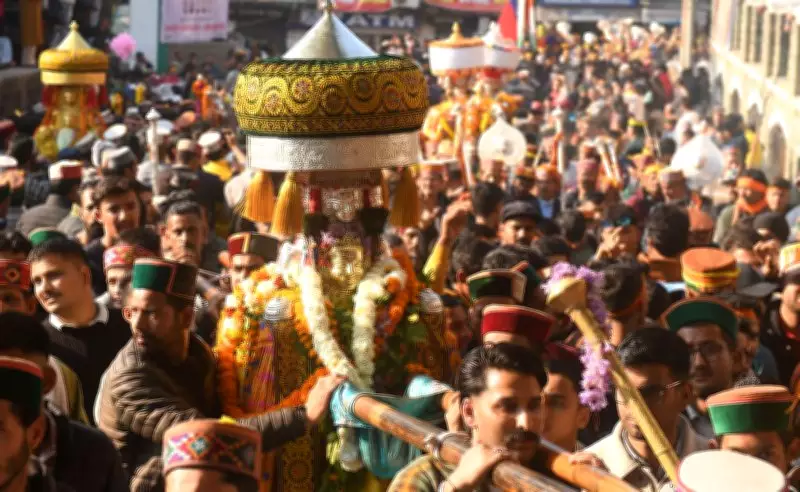
What makes this system durable is its organisational architecture. The Dev Samaj — the deity system — is not a vague cultural force. It is a precisely structured institution. Khasha social life is organised through clans called Khunds. Within each Khund, families form the base unit; villages are governed by a Siana, an elder whose authority is typically hereditary, drawn from one or two dominant families. Several villages together are presided over by a Jetha. Above them sits the Dev Samaj committee, headed by the Vazir, assisted by the Bhandari and the priest. Pronouncements are delivered through the gur, the oracle — who channels the deity's will. The chain is male, and exclusively Khasha. Dalits appear in this system only at its margins: carrying drums, performing menial labour, present in body but absent in voice.
Here lies a crucial fracture that is easy to miss. The Dev Samaj governs social life with near-total authority — marriage, ritual, belonging, the movement of deities through villages, the question of who may enter whose home. But it does not govern the economy. Mercantile transactions, land use, contractual relationships — these fall under constitutional jurisdiction. The Khasha will not eat with a Dalit, but he will sell to him, buy from him, employ him under the law.
This split between the social and the economic is not incidental. It is what allows the system to persist: it imposes social costs of enormous gravity while leaving the material world untouched. The caste order is reproduced not through economic coercion alone but through the far more intimate coercion of belonging.
The Punishment and the Resistance
The punishment the Dev Samaj was prepared to inflict on Sonu and Bali was, in its social weight, a form of civil death. They would have been barred from entering their homes — their families, under community pressure, would have refused them. They would have been excluded from all social and religious functions: no weddings, no funerals, no communal labour. The deity's procession, which visits homes in rotation through the year to bestow blessings, would have passed their thresholds without stopping. Their children's chances of marriage within the community would have been destroyed. And over all of this hung the theological threat: those who defy the deity will perish, Gal Jana in the local tongue — and worse, those who associate with the defiant risk the same fate. The sanction is social and sacred simultaneously, which is precisely why it is so difficult to break.
And yet, Sonu and Bali did not break. When the Dev Samaj committee convened and moved to censure them, both men refused to perform the ritual apology: the Naak Ragadna, the rubbing of the nose. They did something more subversive: they asked for a written show-cause notice, and for a meeting of the Desh, which is the full house comprising all family heads.
The committee understood what this meant. A written notice would constitute evidence of a parallel governance structure operating in violation of constitutional protections. It could invite criminal proceedings. The committee retreated.

It tried a different route: pressuring the gur to declare the verdict through the oracle. The gur demurred: this was a political matter, he said, not a spiritual one. It then reached out to four other Khunds, asking them to enforce the social boycott. They too declined, insisting this was an internal matter of one Khund. The outsiders visited Sonu and Bali at home.
The Role of Political Consciousness
It is worth asking why these two men had the knowledge and the nerve to do what they did. The answer lies in a history that the official narrative of Himachal's peaceful hill culture tends to erase: the radical student movement that, through the 1980s and 1990s, worked in precisely these communities, building political consciousness among young Khashas, teaching them to read the Constitution as an instrument of their own liberation rather than a distant abstraction. Sonu and Bali are, in some sense, its long-term product.
They knew that a written notice was a legal weapon. They knew which provisions of the SC and ST (Prevention of Atrocities) Act could potentially be invoked. They knew that the gur's evasion and the committee's retreat were not spontaneous, but induced by the spectre of accountability.
This matters enormously for the question of strategy. The caste order in the hills has survived seven decades of democracy not because the Constitution is irrelevant but because its provisions have been applied selectively, partially and only when someone knows how to invoke them.
The architecture of atrocity legislation exists. What has been missing is the political formation that can make that architecture legible and usable to those it is meant to protect.
Reforming or Confronting the Dev Samaj?
This episode revives a question that Ambedkar posed and Himachali progressives have long sidestepped: can the Dev Samaj be reformed from within, or must it be confronted as a system whose foundational premise — the hierarchical ordering of human worth by birth — is incompatible with constitutional democracy?
The evidence from Mohri suggests that the answer cannot be deferred by incrementalism. The Dev Samaj did not moderate itself out of conscience. It retreated because it feared legal consequence. The moment that fear recedes, the moment the Sonus and Balis of these hills are isolated, without the backing of a political formation or the knowledge of their rights, the system reasserts itself. What Sonu and Bali demonstrated is that the system can be outmanoeuvred by those who have been politically prepared to do so.
That preparation is not accidental. It is the slow, unglamorous work of building consciousness in communities where caste presents itself as a divine order. The radical student movement did some of that work. Constitutional literacy campaigns can do more. But both require something the current political climate is actively hostile to: a sustained commitment to the idea that social transformation is a prerequisite for, not a byproduct of, economic development.
Sonu and Bali still live in Mohri. The deity still passes through the valley. The Dev Samaj committee still meets. Nothing has been resolved, and that is precisely the point. The meal was not a rupture. It was a crack. What grows through that crack depends entirely on whether the forces that produced these two men continue their work, or whether the Himalayas are left to the silence of the sacred.