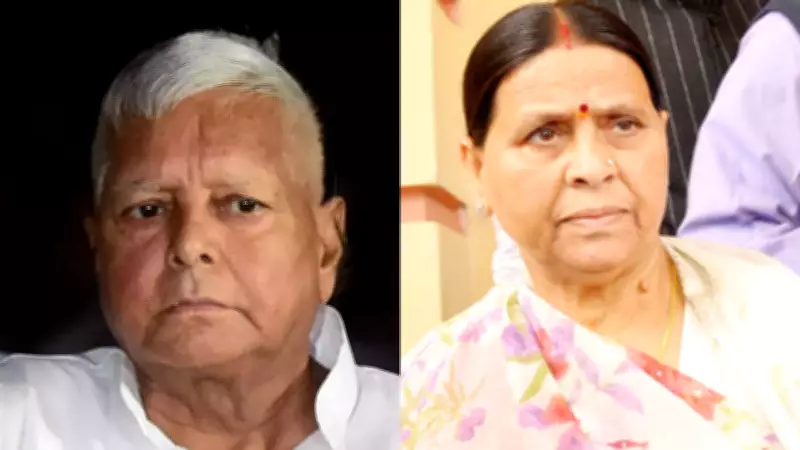
Court Formally Frames Charges in Land-for-Job Scam Against Lalu Prasad Yadav and Rabri Devi
In a significant legal development, the Rouse Avenue Court in New Delhi on Monday formally framed charges against former Railway Minister Lalu Prasad Yadav and former Bihar Chief Minister Rabri Devi in the high-profile Land-for-Job case investigated by the Central Bureau of Investigation (CBI). Both leaders appeared before the court, categorically denied all allegations, and declared their intention to face trial.
Details of the Alleged Scam and Court Observations
The case centers on the serious accusation that Railway Group D jobs were illicitly provided to candidates in exchange for land parcels. Special Judge Vishal Gogne, while framing the charges, emphasized that the accused must appear in person for proceedings unless specifically permitted to attend via video conferencing.
Misa Bharti, daughter of Lalu Prasad Yadav, commented on the court's consideration, stating, "The court has asked them to appear through video conferencing in view of their age and health."

This judicial action follows the court's directive on January 9, which ordered the framing of charges against Lalu Prasad Yadav, Rabri Devi, their children Tejaswi Yadav, Tej Pratap Yadav, Misa Bharti, and other co-accused in this sprawling corruption scandal.
Court's Strong Remarks on the Alleged Conspiracy
In its detailed observations, the court noted, "Prima facie, there was a conspiracy mentored by Lalu Prasad Yadav to use government jobs as a means for getting immovable property through his family members from willing job seekers." The judgment further described the accused family as operating like a syndicate, stating, "Lalu Prasad Yadav and family acted as a syndicate."
The court elaborated on its findings, asserting, "The court finds, on the touchstone of grave suspicion, that there existed an overarching criminal conspiracy, mentored by Mr. Lalu Prasad Yadav, towards using public employment as a bargaining chip for receiving immovable properties through his wife Rabri Devi, daughters Misa Bharti and Hema Yadav as well as sons Tejashwi Prasad Yadav and Tej Pratap Yadav from willing job seekers."
Specific Charges and Legal Proceedings
The charges formally framed include criminal conspiracy, cheating, and offences under the stringent Prevention of Corruption Act. Special Judge Gogne remarked, "Chargesheet strongly depicts the acquisition of the land in lieu of a job."
The court directed the framing of common charges against Lalu Prasad Yadav, Rabri Devi, Misa Bharti, Hema Yadav, Tejaswi Prasad Yadav, Tej Pratap Yadav, Bhola Yadav, R.K. Mahajan, and Prem Chand Gupta.
Defense Arguments and Counterclaims
During the arguments, senior counsel Maninder Singh, representing Lalu Prasad Yadav, vehemently contested the charges, labeling the case as politically motivated. He argued, "There is no evidence to show that jobs were given to candidates in lieu of land. There are sale deeds which show that lands were purchased for money."
Singh further elaborated, "There was no recommendation by former Railway Minister Lalu Prasad Yadav for any candidate. No General Manager has stated that he ever met Lalu Prasad Yadav. No evidence indicates that any land was taken without compensation. The land was purchased."
Similarly, arguments presented on behalf of Rabri Devi asserted, "Rabri Devi purchased land and paid money for it. Buying land for money is not a crime. No favour was given to any accused candidate. These transactions are not connected."
Broader Case Details and Discharges
The CBI originally registered this case on May 18, 2022, and has since filed two charge sheets along with two supplementary charge sheets. The agency alleges a systematic scheme where Group D Railway jobs were bartered for land.
In its observations, the court noted, "Several accused General Managers of the Indian Railways emerge prima facie as having made these appointments by abuse of their discretion to engage Group D substitutes in the Railways." However, it clarified that the accused Chief Personnel Officers (CPOs) lacked the authority to appoint substitutes and were not influenced by the Railway Minister, leading to their discharge.

The court discharged 52 accused individuals, including CPOs and various Railway officials, while noting that five accused had died during the lengthy legal proceedings. The CBI had initially charge-sheeted a total of 103 individuals in this complex case.