

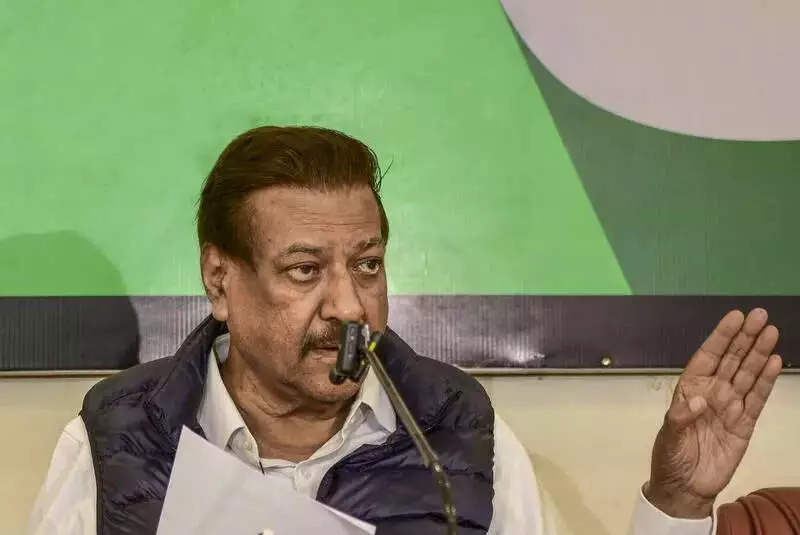
Former Union Minister and senior Congress leader Prithviraj Chavan sparked a debate on Tuesday by raising fundamental questions about the structure and size of the Indian Army in the context of modern warfare. Speaking to reporters in Pune, the former Maharashtra Chief Minister argued that the nature of future conflicts may not require a massive standing army in the traditional sense.
Rethinking Army Size in the Nuclear Age
Chavan pointed to the existing military imbalance between India and Pakistan, noting that India maintains a force of 12 to 15 lakh soldiers compared to Pakistan's 5 to 7 lakh. However, he contended that this numerical superiority has become less significant. "Considering both India and Pakistan are nuclear powers, no country in the world will allow a full-fledged war between them," Chavan stated. He emphasized that in such a scenario, it matters little whether India has 12 lakh, 25 lakh, or even one crore soldiers, as the era of superiority through sheer numbers has ended.
The Congress veteran elaborated that the chances of large-scale, man-to-man combat in future wars are diminishing. He suggested that the excess personnel in the Army could be redirected and utilized for purposes other than direct combat. To support his argument, Chavan referenced Operation Sindoor, the aerial engagement between India and Pakistan, highlighting that the conflict was primarily fought in the skies. "The Indian Army did not have to move at all," he remarked, underscoring the shift in warfare domains.

A Candid Critique of Congress's Strategy
Shifting focus to his own party, Prithviraj Chavan delivered a blunt assessment of the Congress's recent political and electoral challenges. He admitted that the party has failed to effectively champion issues that resonate directly with the common citizen. Initiatives like the Samvidhan Yatra and Tiranga Yatra, according to him, failed to attract the broader public, especially the youth, and saw participation largely limited to party members.
"I personally feel that we fell short of raising issues of unemployment, farmers' crisis, and inflation, which are directly connected with youths and farmers," Chavan said. He criticized the current central government's development model as "lopsided," overly focused on big-ticket infrastructure projects while ignoring the pressing everyday concerns of ordinary people.
Chavan expressed shock over the party's performance in the recent Bihar assembly elections and confirmed that an internal assessment is underway. He also voiced disappointment at the Congress's inability to resolve the internal conflict between Karnataka Chief Minister Siddaramaiah and his deputy, D.K. Shivakumar.
Reflections on Military Strategy and Political Posturing
Returning to defense matters, Chavan offered a stark analysis of Operation Sindoor, claiming, "Accept it or not, we completely lost the battle on the first day after our aircraft were shot down." He described a situation where the entire Indian Air Force was effectively grounded due to the high risk of further losses, preventing sorties from bases like Gwalior, Bathinda, or Sirsa.
On the state political front, Chavan criticized the ruling coalition in Maharashtra for breaking with tradition by not offering the post of Leader of the Opposition to the Congress. He held the Chief Minister responsible for this decision, which he sees as undermining democratic norms.
Chavan concluded by reiterating India's economic advantage, stating, "Our economy is 10 times bigger than Pakistan's," implying that comprehensive national strength, not just military manpower, defines power in the contemporary world.






