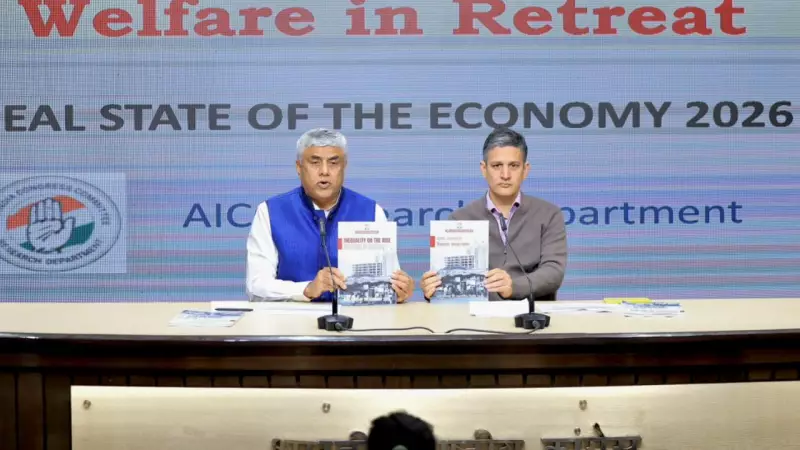
Congress Accuses Modi Government of Economic Data Manipulation Ahead of Budget Session
In a scathing critique ahead of the crucial budget session, the Congress party on Tuesday launched a sharp attack on the Modi government, accusing it of presenting a misleadingly positive picture of the Indian economy through questionable data practices. The opposition party expressed deep concern over what it described as "fudged statistics" that mask underlying economic distress, rising inequality, and diminishing welfare measures.
Congress Releases 'Real State of Economy 2026' Report
Anticipating what it called government "propaganda" during the upcoming President's joint address to Parliament, economic survey presentation, and Union budget announcement, Congress proactively released its own assessment titled "Inequality on the Rise, Welfare in Retreat". Party spokespersons Rajeev Gowda and Amitabh Dubey unveiled this annual report, positioning it as an alternative narrative to official government claims.
"The government would indulge in propaganda in the coming days, so we are putting facts before the people through our real state of the economy 2026 report," the Congress leaders stated, framing their document as a necessary corrective to official narratives.

Questioning Official Economic Indicators
The Congress report challenges multiple government economic indicators with specific data points:
- GDP Discrepancy: Citing former economic advisor Arvind Subramanian's calculations, Congress claims India's GDP figures are inflated by at least 2.5% compared to actual economic reality.
- Manufacturing Contradiction: While official data shows manufacturing growing at 8.4% in the first half of 2025-26, the Index of Eight Core Industries indicates only 2.9% growth, revealing what Congress calls a significant statistical gap.
- Currency Performance: The report highlights that the Indian Rupee has been Asia's worst-performing currency in 2025, contradicting government narratives of economic strength.
- Inflation Reality: Congress dismisses the official 0.5% inflation rate as disconnected from people's lived experiences, noting that the International Monetary Fund (IMF) has given India's statistics only a C grade.
Alarming Employment and Inequality Trends
The Congress report presents several concerning trends about India's employment landscape and wealth distribution:
- Manufacturing Decline: Between 2017-18 and 2023-24, the share of workers in manufacturing fell from 12.1% to 11.4%, while agricultural employment rose from 44.1% to 46.1%, indicating what Congress calls "reverse structural transformation."
- Job Quality Concerns: "Job growth is concentrated in low value, informal, and gig economy sectors," the report states, questioning the quality of employment generation.
- Extreme Inequality: The top 10% of Indians capture 58% of national income while the bottom half receives only 15%. Wealth distribution shows even greater disparity, with the top 10% owning 65% of India's wealth.
- Poverty Persistence: Four out of five Indians subsist on less than Rs 200 per day, according to the Congress analysis.
Household Financial Stress and Welfare Erosion
The report highlights deepening financial vulnerability among Indian households:
- Net household financial savings have plummeted to a five-decade low of 5.2%
- Household debt has sharply risen to 41% from 35% in 2019
Congress particularly criticized what it called the "dismantling" of the Mahatma Gandhi National Rural Employment Guarantee Act (MGNREGA), describing it as "the best welfare net for the poor" whose erosion will "hurt the deprived sections the most."
The comprehensive critique comes at a politically sensitive moment, with the government preparing to present its economic vision through the budget, while the opposition seeks to frame the economic debate around questions of data credibility, distributional justice, and welfare priorities.