

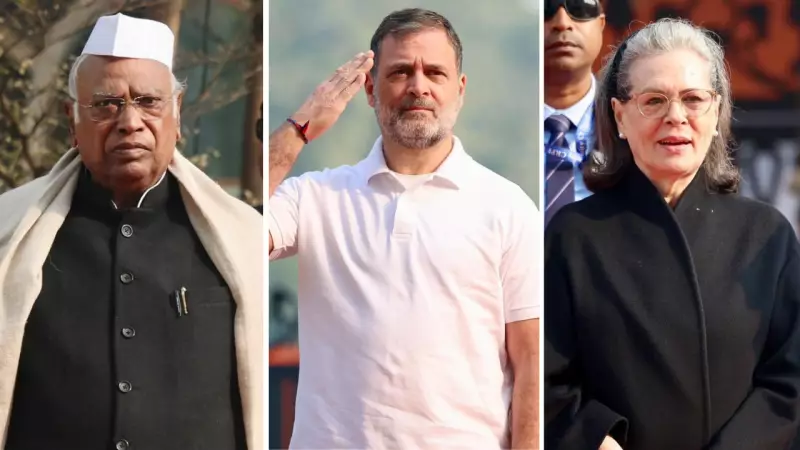
Mahatma Gandhi once imagined a quiet end for the Indian National Congress after Independence, where it would transform into a Lok Sevak Sangh and return power to the people. History, however, took a different, more dramatic turn. The party persisted, accumulating a heavy legacy over decades. Now, at 140 years old, it is older than independent India itself and remains locked in a relentless struggle for electoral survival.
From Dominance to Damage Control: A Party at a Crossroads
Founded in 1885, the Congress did not merely witness the birth of modern India; it authored a significant part of the script. Today, the party that once defined the nation's political centre is struggling to find it again. Its slogans are loud, its marches long, and its symbolism familiar, yet dominance has been replaced by damage control. Nostalgia, it has learned, no longer guarantees votes.
As it steps into its 141st year, the party has little time for birthday celebrations. A series of assembly elections across five states—Kerala, Assam, Tamil Nadu, West Bengal, and Puducherry—looms as its next critical reality check. These polls will test whether fresh campaign strategies, revived alliances, and hard lessons from a bruising 2025 can finally yield results.

Rebranding the Battle Cry: From 'Save Constitution' to MGNREGA Protests
The Congress's recent campaign themes—'Save the Constitution,' 'vote chori,' and caste surveys—failed to translate into votes, despite Rahul Gandhi's extensive Bharat Jodo Yatra covering over 1,300 kilometres. For 2026, the party has pivoted, announcing nationwide protests against the BJP-led government's move to replace the rural employment scheme, MGNREGA, with the VB G-RAM-G law.
Congress President Mallikarjun Kharge declared the campaign would begin on January 5, pledging to "democratically oppose every conspiracy to remove Gandhiji's name from MNREGA." However, a crucial question remains: will the scheme's beneficiaries, whose welfare the party claims to champion, connect with this narrative of a "conspiracy" against Gandhi's name, or are they more concerned with the scheme's practical dilution and structural changes?
State-by-State Battleground: Uphill Fights Across India
The upcoming state elections present a complex mosaic of challenges and opportunities for the Grand Old Party.
In Kerala, the Congress-led UDF gains strategic momentum from a strong showing in local body polls and visible anti-incumbency against the ruling LDF. However, the BJP's expanding footprint, evidenced by its win in Trivandrum, complicates the traditionally bipolar contest.
In Assam, still reeling from its 2016 defeat, Congress is attempting a grassroots revival. Its "Raijor Podulit Raijor Congress" campaign involves crowdsourcing manifesto ideas through thousands of 'aspirational boxes' and focusing on jobs, tea workers' wages, and flood management. Its decision to contest 100 of 126 seats, however, has strained opposition alliances.
In Tamil Nadu, the party walks a tightrope within the DMK-led alliance, balancing the desire for more seats with its weak independent base and the risk of appearing disruptive.
The situation is dire in West Bengal. Once a significant player, Congress drew a blank in the 2021 assembly polls. Squeezed out by the TMC-BJP bipolar contest and with Mamata Banerjee refusing alliances, the party fights merely to remain a credible political force.
Leadership Churn and the Ghost of 2025
Internal murmurs about leadership have resurfaced, with some voices informally suggesting Priyanka Gandhi Vadra as a potential unifying figure. This follows a letter from a former Odisha MLA questioning Kharge's effectiveness and citing a disconnect with the youth. These discussions highlight the party's unresolved succession questions and its struggle to balance generational change with its enduring reliance on the Gandhi family.

The shadow of 2025's electoral disappointments hangs heavy. Despite Rahul Gandhi's highly visible 1,300-km padyatra in Bihar and constant headlines, the Congress suffered severe losses in Haryana, Maharashtra, Madhya Pradesh, Rajasthan, and Delhi. The year demonstrated a persistent gap between high-visibility optics and ground-level organisational weakness. The sole exception was Jharkhand, where survival depended on a strong alliance with the JMM.
As the Indian National Congress faces another defining year, its challenges are clear. It must convert consultation into votes, rebrand its protest politics to resonate with public priorities, manage fragile alliances, and address leadership anxieties. The grand old party is indeed at a crossroads, under immense pressure to prove it still knows the path forward.





