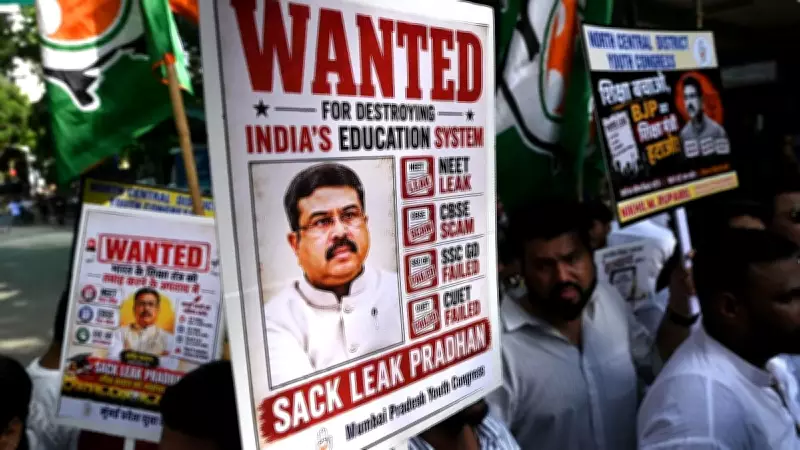
The Congress party on Tuesday demanded the resignation of Union Education Minister Dharmendra Pradhan, accusing him of a 'political hack with zero integrity' over the Central Board of Secondary Education's (CBSE) new three-language formula. The controversy erupted after the CBSE released a circular outlining the implementation of the three-language formula under the National Education Policy (NEP) 2020, which has been met with criticism from opposition parties and some states.
Congress's Allegations
Congress spokesperson Pawan Khera alleged that Pradhan's actions were a 'political hack' aimed at undermining the federal structure and imposing Hindi on non-Hindi speaking states. 'This is a clear violation of the spirit of the Constitution and the principles of federalism. The minister has shown zero integrity by pushing this agenda,' Khera said. The party has called for an immediate resignation of the minister, stating that his continuation in office would be detrimental to the unity of the country.
CBSE's Three-Language Formula
The CBSE's new circular mandates that schools affiliated with the board must offer three languages from classes 6 to 8, with at least two being native Indian languages. This move is in line with the NEP 2020, which recommends a three-language formula to promote multilingualism. However, critics argue that this could lead to the imposition of Hindi on non-Hindi speaking regions, as the policy does not specify which languages are to be taught, leaving it to the discretion of schools.

Political Reactions
The demand for Pradhan's resignation has been echoed by other opposition parties, including the DMK and the Trinamool Congress, who have termed the move as an attack on regional languages. The DMK, which leads the government in Tamil Nadu, has been particularly vocal against the three-language formula, arguing that it is an attempt to undermine Tamil and other Dravidian languages.
In response, Union Minister Dharmendra Pradhan defended the CBSE's decision, stating that the three-language formula is flexible and respects the linguistic diversity of the country. 'The NEP 2020 does not impose any language on anyone. It only encourages the learning of multiple languages to enhance cognitive abilities and cultural understanding,' Pradhan said in a statement.
Background of the Controversy
The three-language formula has been a contentious issue in Indian education policy for decades. The original formula, proposed in 1968, recommended the study of Hindi, English, and one modern Indian language in Hindi-speaking states, and the study of the regional language, Hindi, and English in non-Hindi-speaking states. However, several states, particularly in the south, have resisted the imposition of Hindi, leading to a long-standing debate.
The NEP 2020, introduced by the central government, revives the three-language formula but with greater flexibility. It states that no language will be imposed on any state, and students will have the choice to learn languages of their interest. However, the recent CBSE circular has reignited the controversy, with opposition parties accusing the government of using the board to push a political agenda.
Implications for Students and Schools
The new CBSE directive has left many schools and parents confused about the implementation. Schools are now required to offer at least three languages from classes 6 to 8, which could strain resources and increase the burden on students. Some education experts have welcomed the move, saying it will promote linguistic diversity, while others have criticized it for being impractical.
The Congress party has announced that it will raise the issue in Parliament and plans to hold protests across the country. 'We will not allow this attack on our linguistic identity. The minister must resign for his undemocratic and divisive actions,' Khera added.