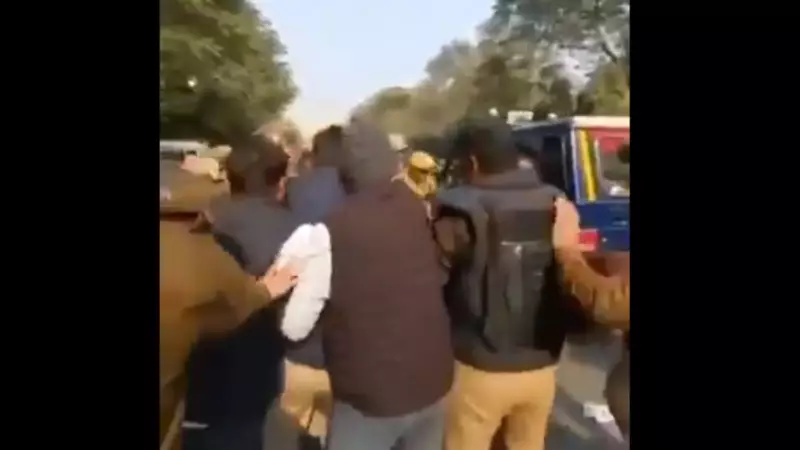
The Congress party staged significant demonstrations in Varanasi on Sunday, vehemently opposing the central government's decision to repeal the Mahatma Gandhi National Rural Employment Guarantee Act (MGNREGA). The protests, which saw a symbolic fast by state unit chief Ajay Rai, were met with police action leading to the arrest of over 100 members of the National Students' Union of India (NSUI).
Police Action and Student Arrests in Prime Minister's Constituency
The protest escalated when NSUI workers attempted to march from the Lanka Gate of Banaras Hindu University towards the local office of Prime Minister Narendra Modi. According to the Congress, the police responded with a lathi-charge on the peaceful student march. Over 100 NSUI activists were reportedly injured, arrested, and taken to various police stations across Varanasi.
NSUI national president Varun Chaudhary condemned the police action, stating that the Modi government resorted to repression in the Prime Minister's own Lok Sabha constituency. He alleged that pre-emptive police raids were conducted on hostels and student residences in Varanasi and eastern Uttar Pradesh a day prior to the planned "Save MGNREGA" march, with many students being placed under house arrest.

Political Accusations and the Gandhi Legacy
In a parallel development in Amethi, local Congress MP Kishori Lal Sharma launched a sharp attack on the ruling Bharatiya Janata Party (BJP). He drew a controversial parallel, accusing the BJP of being aligned with the same communal forces responsible for the assassination of Mahatma Gandhi. Sharma claimed these forces are now attempting to "erase his name from the country and shatter his dreams," which he said were being realized through schemes like MGNREGA.
The protest centered on the Centre's move to replace the landmark rural job guarantee scheme with a new legislation named the Viksit Bharat-Guarantee for Rozgar and Aajeevika Mission (Grameen) Act, abbreviated as VB-G RAM G. The Congress views this as a dilution of the rights-based framework of MGNREGA, which guarantees 100 days of wage employment to every rural household.
Fallout and Future Implications
The events in Varanasi highlight the growing political friction over the government's social welfare policies. The use of force against student protesters in a high-profile city like Varanasi is likely to intensify the debate on the right to peaceful assembly. The Congress party has framed the repeal of MGNREGA not just as a policy shift, but as an ideological assault on the legacy of Mahatma Gandhi, setting the stage for a broader political narrative in the lead-up to future elections.
The allegations of widespread arrests and a police lathi-charge have put the spotlight on the state administration's handling of dissent. As the new VB-G RAM G Act comes into effect, the opposition is expected to continue its mobilization, using incidents like the Varanasi protest to galvanize support among rural and student communities.