

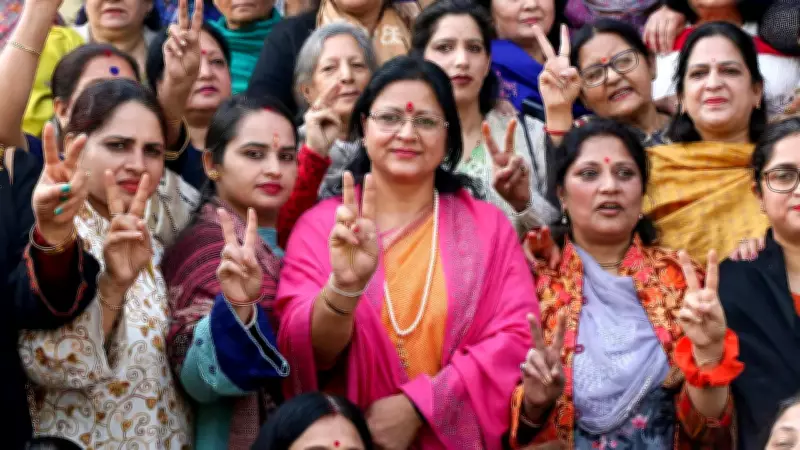
Congress and Opposition Parties Clash with Government Over Women's Reservation Bill Timing
In a heated session of the Rajya Sabha, Congress and several opposition parties strongly opposed the government's proposal to introduce amendments to the women's reservation law during the upcoming Parliament sitting starting April 16. The opposition members accused the ruling party of attempting to gain political advantage in the forthcoming assembly elections through this strategic timing.
War of Words Erupts in Upper House
The controversy sparked intense exchanges between treasury and opposition benches immediately following the Question Hour on Thursday. Congress MP Jairam Ramesh launched a sharp critique of the government's position, highlighting what he described as inconsistent reasoning regarding implementation requirements.
"When the Nari Shakti Vandan Adhiniyam was passed in this House on September 23, 2023, the Leader of Opposition and other opposition members had urged the government to implement it from the 2024 Lok Sabha elections," Ramesh stated. "At that time, the government claimed they couldn't proceed without conducting the Census and delimitation first. For thirty months they remained inactive, and suddenly they've discovered that neither census nor delimitation is necessary because they face electoral challenges in West Bengal and Tamil Nadu. This is purely political maneuvering."

Government Defends Legislative Timing
Leader of the House J P Nadda firmly rejected the opposition's criticism, asserting the government's prerogative to determine when legislation should be introduced. "The government has every right to decide on the appropriate timing for bringing forward legislation," Nadda declared, defending the administration's approach to parliamentary procedure.
Earlier in the session, Leader of Opposition Mallikarjun Kharge expressed support for women's reservation in principle but cautioned against what he termed political gamesmanship regarding the bill's introduction. "We all support reservation for women, but the government should not engage in tactical games about when and how to present this Bill," Kharge emphasized.
Minister Rijiju Emphasizes National Commitment
In response to the opposition's charges, Minister Kiren Rijiju articulated the government's perspective, framing the issue as a matter of national duty rather than electoral calculation. "What remains paramount is our bound duty and commitment that the Parliament of India has made to the women of this nation," Rijiju asserted during the parliamentary debate.
The minister continued: "This legislative action has no connection to specific state elections. We must advance this initiative because we face certain limitations when considering the timeline. Let us avoid politicizing this crucial matter that affects millions of women across the country."
The parliamentary confrontation underscores deepening tensions between the ruling coalition and opposition parties regarding both the substance and timing of significant social legislation. With assembly elections approaching in several states, the debate over the women's reservation bill has become emblematic of broader political conflicts within India's parliamentary democracy.






