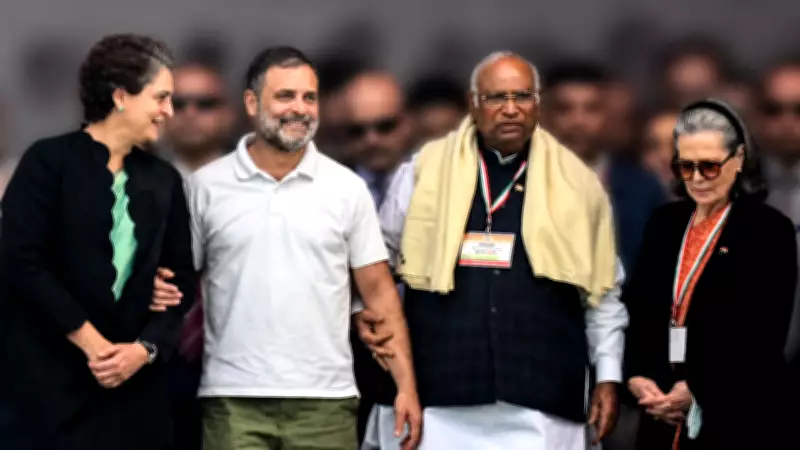
In June 2013, Prime Minister Narendra Modi declared at a BJP national executive meeting in Goa, "Congress-mukt Bharat banana hai." This slogan aimed to galvanize party cadres for the 2014 Lok Sabha challenge when the Congress ruled 14 states and was in its ninth year at the Centre. Initially seen as political rhetoric, the 2014 elections saw the BJP storm to power, reducing the Congress to 44 seats—its worst performance ever. This marked the beginning of a dramatic decline that shrank the Congress footprint across India.
The Decline at the Centre
In September 2013, when Narendra Modi became the BJP's prime ministerial candidate, the Congress had 206 members in Lok Sabha. The 2014 elections reduced it to 44 seats, denying it the constitutional post of Leader of Opposition. In 2019, the BJP expanded to 303 seats while the Congress only reached 52, still insufficient for the LoP post. This raised fears that "Congress-mukt Bharat" might become reality. However, the party's darkest years also saw seeds of recovery. The Congress allied with regional parties to form an anti-BJP front, and in the 2024 elections, it nearly doubled its Lok Sabha tally to 99, regaining the LoP post after a decade. The BJP slipped to 240 seats, its first sub-majority since 2014, forcing it to rely on allies like TDP and JD(U). The Congress declared the election a "moral and political loss" for Modi.
The Roller Coaster Ride in States
The Congress's decline in states was equally stark. From ruling 14 states in 2013, it fell to just three. Yet, occasional state election wins prevented complete wipeout. Rahul Gandhi's Bharat Jodo Yatra in 2022, a 4,000-km march from Kanyakumari to Kashmir, helped reclaim political ground. Though it did not immediately translate into votes, it gave the Congress a public face and renewed Rahul's connect with voters. Electoral returns came in 2023 with victories in Telangana and Karnataka, followed by Himachal Pradesh in late 2022. By 2026, the Congress footprint expanded in the south.

The 2026 Verdict in Kerala and Tamil Nadu
In Kerala, the Congress-led United Democratic Front won 102 seats, its strongest mandate since 1977, with the Congress alone securing 63. The Left Democratic Front was reduced to 35 seats, and Pinarayi Vijayan resigned. For the first time in 50 years, no Communist party governs any state. In Tamil Nadu, the Congress ended an 11-year alliance with the DMK to align with Vijay's TVK, which won 108 seats but fell short of a majority. The Congress's support ensured it remains at the political table in a state where Dravidian parties have dominated for decades.
What's Next for the Congress?
The Congress has high stakes in upcoming elections, particularly in Punjab and Uttar Pradesh (in alliance with the Samajwadi Party). Punjab assembly elections next year could be a major opportunity, as the AAP government faces internal turbulence and governance pressures. The Congress, as the principal opposition, hopes to reclaim the state, but success depends on resolving internal divisions and presenting a coherent alternative—work that has yet to seriously begin. The BJP has signaled an aggressive Punjab campaign.
'Congress-Yukt Bharat'
The road ahead remains uphill. Despite electoral successes, the Congress still lags behind the BJP. Regional heavyweights like Arvind Kejriwal and Mamata Banerjee have suffered setbacks, offering the Congress an opportunity to reclaim lost ground. The key question is whether its revival stems from strategy or merely from allies' and BJP's mistakes. Current gains seem incidental, driven by state leaders rather than Rahul Gandhi's interventions. For long-term revival, the Congress needs Rahul to become a full-time politician, focusing on grooming local leaders and smart alliance management. The BJP's dream of "Congress-mukt Bharat" remains just a dream—the country is still Congress-yukt.
About the Author: Priyanka Mukherjee is an Assistant News Editor at The Times of India, covering breaking news, long-form explainers, and stories on women's rights and social change.