

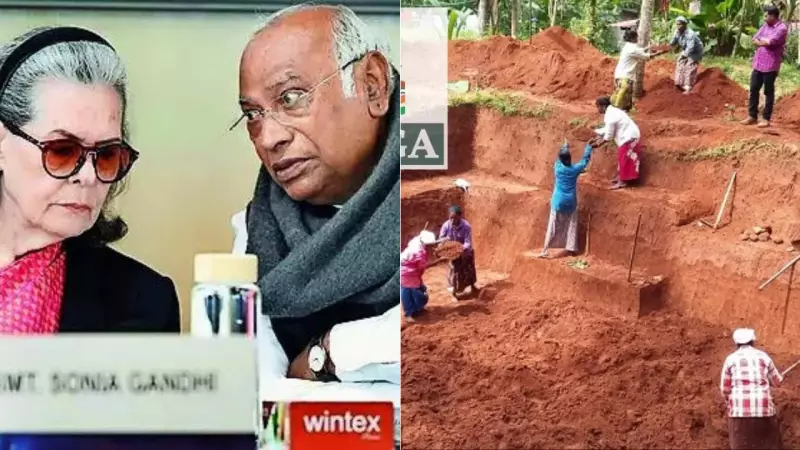
The Indian National Congress has officially declared a nationwide struggle to restore the Mahatma Gandhi National Rural Employment Guarantee Act (MGNREGA). The party announced a 45-day agitation programme, titled 'MGNREGA bachao sangram', starting from January 8. Alongside this mass mobilization, the party has stated its intention to legally challenge the new VB-G RAM G law in court, alleging it violates a key constitutional provision.
A Three-Tiered Agitation Plan
Congress leaders K C Venugopal and Jairam Ramesh unveiled a detailed three-level plan for the agitation. The protest will begin with outreach at the grassroots panchayat level and culminate in four major national rallies. The party aims to replicate the success of the farmers' movement that led to the rollback of the three farm laws. Congress President Mallikarjun Kharge emphasized the party's commitment to peaceful yet firm resistance, stating, "We will resist, peacefully and firmly, from every panchayat to Parliament." The All India Congress Committee (AICC) clarified that this 45-day programme is merely the first phase of the larger 'sangram' (struggle), which will extend beyond February 25.
The Core Constitutional Challenge
The primary legal argument against the VB-G RAM G law centres on funding and federalism. Jairam Ramesh explained that while MGNREGA was entirely the financial responsibility of the Central government, the new law explicitly mentions a 60:40 funding share between the Centre and the states. He pointed to Article 258 of the Constitution, which allows for putting financial burden on states only "as may be agreed upon." Ramesh asserted that no such discussion or agreement was held with the states, making the law a direct violation. "The law is a violation of Article 258 and we will challenge it in court," he declared.

Alleged Motive and Impact on Panchayats
Congress leaders accused the central government of deliberately attempting to dismantle the job guarantee scheme by shifting the financial onus onto states. Venugopal and Ramesh jointly argued, "Centre has put 40% financial burden of the job scheme under the new law on the states. No state is in a position to provide these funds. So, the idea is to end the scheme." Furthermore, Venugopal highlighted the adverse impact on local governance, warning that the new law will deprive panchayats of both funds and the right to plan work, thereby undermining the decentralised structure that was a cornerstone of MGNREGA.
The stage is now set for a significant political and legal battle over one of India's most prominent social welfare schemes, with the Congress party mobilising public pressure and preparing for a courtroom confrontation.






