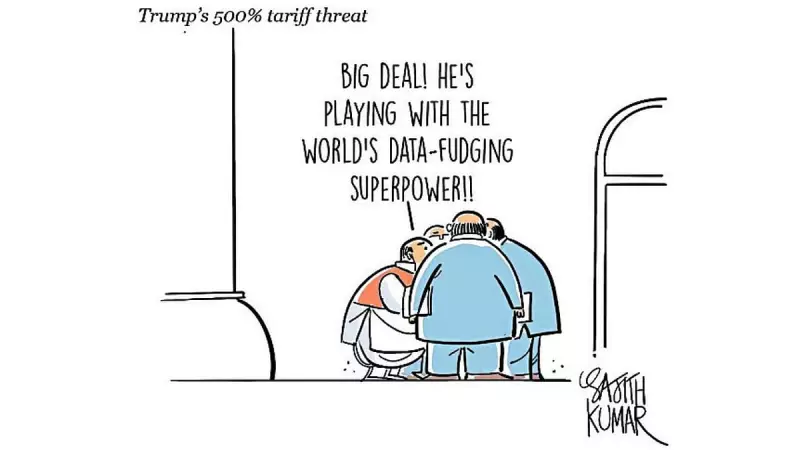
In its latest edition, the renowned Deccan Herald newspaper has published a pointed editorial cartoon that has captured the attention of readers and political observers alike. Titled "DH Toon: Big Deal," the illustration serves as a powerful piece of visual commentary on a recent and significant political development within the country's governance landscape.
The Art of Political Satire
Editorial cartoons have long been a cornerstone of Indian journalism, using wit and imagery to distill complex political scenarios into accessible and often provocative commentary. The Deccan Herald cartoonist continues this proud tradition with the "Big Deal" toon. The artwork does not merely report the news but interrogates it, asking readers to look beyond the official announcements and political rhetoric to consider the substantive impact and the underlying narratives.
While the specific visual elements of the cartoon are proprietary to Deccan Herald, the genre typically employs symbolism, caricature, and metaphorical scenarios to convey its message. Such cartoons might personify political parties or ideologies, use scale to emphasize disparity between promise and reality, or incorporate familiar cultural icons to frame the political discourse within a shared public understanding.

Contextualizing the 'Big Deal'
The cartoon's title, "Big Deal," is itself a loaded phrase, often used to express sarcasm or to question the true significance of an event being touted as monumental. By choosing this label, the cartoonist immediately sets a tone of skepticism. The illustration likely comments on a recent high-stakes agreement, policy announcement, or political alliance that has been promoted by its architects as a major breakthrough or a transformative moment for the nation.
The power of this form of journalism lies in its ability to bypass lengthy analysis and strike directly at the perceived heart of the matter—whether it be highlighting potential contradictions, pointing out overlooked consequences, or simply holding power to account through ridicule. In a vibrant democracy like India, such satirical work is not just entertainment; it is a vital form of civic engagement and critique.
Reactions and Public Discourse
Publications like Deccan Herald release these cartoons with the expectation that they will spark conversation and debate. A successful editorial cartoon becomes a talking point, shared on social media and discussed in public forums. It can galvanize support for a particular viewpoint or, conversely, draw criticism from those who feel it misrepresents a situation. This dynamic interaction between the media and the populace is essential for a healthy public sphere.
The "DH Toon: Big Deal" enters this fray at a time when political discourse in India is particularly charged. It serves as a mirror, reflecting back to the public and the political class a certain perspective on current events. The cartoon's effectiveness is measured by its resonance—does it articulate a silent question many are asking? Does it challenge the official story in a way that feels truthful to the audience's experience?
By distilling a complex political moment into a single, potent image, the cartoon achieves what thousands of words sometimes cannot: it provides an immediate, emotional, and intellectual reaction to the day's events.
The Role of Editorial Cartoons in Modern Media
In an era dominated by digital news bites and 24-hour television channels, the editorial cartoon remains uniquely relevant. It is a form of slow journalism in a fast world, requiring the reader to pause and interpret. It combines the skills of an artist with the insight of a seasoned journalist and the fearlessness of a commentator. For Deccan Herald, maintaining this tradition underscores its commitment to offering diverse forms of analysis and critique beyond standard reportage.
These cartoons also have a historical function, capturing the mood and concerns of a specific political moment for posterity. Future historians will look at collections of such cartoons to understand the public sentiment and the key issues that defined an era. "DH Toon: Big Deal" is therefore not just today's commentary but tomorrow's historical document, a snapshot of the skepticism and scrutiny that defines contemporary Indian democracy.

Ultimately, the publication of this cartoon reaffirms the importance of a free press that can employ humor, satire, and art to question authority and prompt deeper reflection among its readership on what truly constitutes a "big deal" for the nation's future.