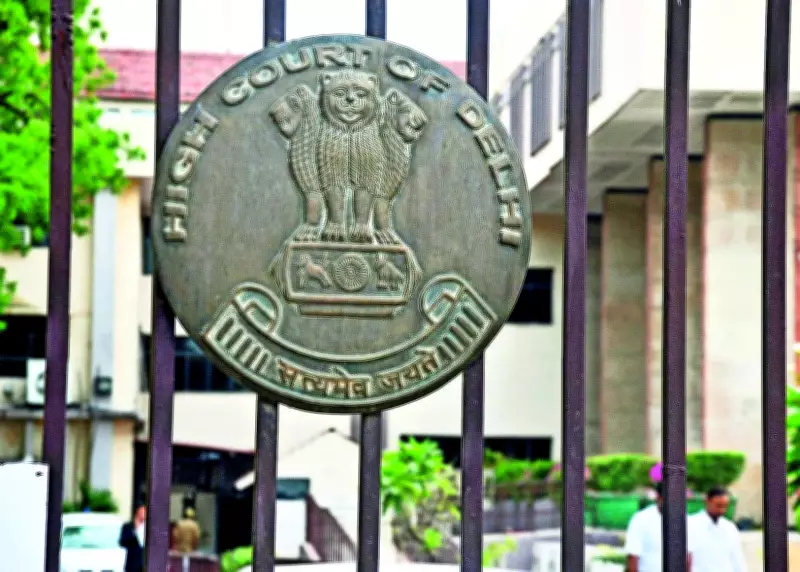
The Delhi High Court on Tuesday reserved its verdict on the bail plea of Athar Khan, an accused in the larger conspiracy case linked to the 2020 Northeast Delhi riots. The court orally observed that WhatsApp chats placed on record prima facie indicated his active involvement in the alleged conspiracy.
Court Observations During Hearing
A bench of Justices Prathiba M. Singh and Madhu Jain made the observations while hearing submissions on behalf of Khan, who challenged a trial court order denying him bail in a case registered under the Unlawful Activities (Prohibition) Act (UAPA). During the hearing, Khan’s counsel cited the chats to argue that the plan among the accused persons was to organise non-violent protests and that there was no intention to incite violence.
The high court, however, questioned why the message was deleted. “To be honest, as third-party people these messages actually prove the conspiracy. They prove that all these people were together. When you conspire like this, things can go out of hand and we all are witness to what happened in 2020. These messages prove you were an active participant. It’s shocking,” the bench said.

Defense Arguments
Khan’s counsel submitted that no weapons, money, or incriminating articles were recovered from Khan and that there was no evidence showing his involvement in any act of violence or rioting. He argued that Khan was, at best, a “local-level facilitator” with no decision-making role in the alleged conspiracy and pointed out that there were several meetings in which his client was not present. The counsel sought parity with co-accused Shadab Ahmad, who was granted bail by the Supreme Court earlier this year, stating that the allegations against Khan were similar in nature. He also submitted that the role attributed to Gulfisha Fatima, who was enlarged on bail by the apex court, was “much graver” as she had allegedly mobilised people.
Prosecution's Opposition
Opposing the plea, Delhi Police argued that Khan’s role could not be equated with those granted bail earlier. “He wasn’t a sidekick. His role can be compared with Umar Khalid and Sharjeel Imam’s. There was a call to kill 100-200 people. His case stands on a different footing,” the prosecution said. The prosecution argued that Khan fell within the category of accused persons alleged to have played a serious role in the conspiracy and, therefore, was not entitled to bail under the parameters laid down in the Gulfisha Fatima judgment.