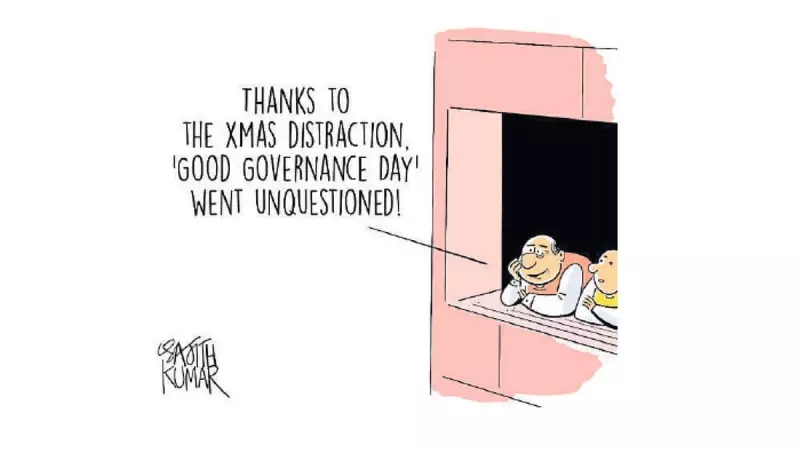
A recent editorial cartoon published by Deccan Herald has sparked conversation with its pointed visual commentary on the observance of Good Governance Day in India. The artwork, released in the context of the Christmas holiday period, uses satire to highlight the perceived political narrative surrounding the day.
The Cartoon's Visual Critique
The cartoon, a staple of the publication's opinion section, employs symbolic imagery to convey its message. Central to the illustration is the juxtaposition of the official commemoration of Good Governance Day with the widespread celebration of Christmas. The artist uses this contrast not to comment on the religious festival itself, but to underscore the political decision-making behind the calendar placement of the governance event.
Through clever visual metaphors, the cartoon suggests a layer of political messaging overlaid on the administrative intent of the day. The artwork implies that the declaration of December 25th as Good Governance Day is perceived by some as a strategic move, potentially overshadowing the traditional holiday with a state-sponsored narrative of administrative efficiency and reform.

Context and Public Sentiment
Good Governance Day was established in 2014 to mark the birth anniversary of former Prime Minister Atal Bihari Vajpayee. Its observance on December 25th has been a subject of discussion and debate since its inception, given the date's significance for the country's Christian community and many others who celebrate Christmas culturally.
The Deccan Herald cartoon taps into this ongoing public discourse. It reflects a segment of public sentiment that views the coinciding dates as more than a simple calendar overlap. The satire questions the prioritization and framing of governance narratives, especially on a day traditionally associated with peace, goodwill, and a break from routine affairs.
Editorial cartoons of this nature serve as a critical mirror to society and polity. They distill complex political debates into a single, impactful image that can communicate nuance, irony, and critique where words sometimes require paragraphs. This particular cartoon functions as a form of visual op-ed, challenging the official story and inviting readers to engage with the politics of symbolism.
Broader Implications of Political Satire
The publication of this cartoon underscores the vital role of a free press and artistic expression in a democracy. It demonstrates how media outlets use satire not merely for humor, but as a legitimate tool for political and social commentary. The cartoon does not dispute the importance of good governance as a concept; rather, it critiques the packaging and timing of its national celebration.
Reactions to such cartoons are often polarized, highlighting the deep political divides in contemporary public discourse. Supporters may see it as a necessary check on power, while critics may view it as disrespectful or politically motivated. This divergence of opinion is, in itself, a testament to the cartoon's effectiveness in provoking thought and dialogue.
Ultimately, the Deccan Herald cartoon is more than a drawing; it is a cultural artifact capturing a specific moment of political tension. It reminds the audience that governance is not just about policies and schemes, but also about perception, communication, and the symbolic weight of official actions. The enduring power of such satire lies in its ability to question, challenge, and hold a mirror to the wielders of power, using ink and wit as its primary tools.